


Why Knowing What Size Air Conditioner Do I Need Saves You Money and Keeps You Comfortable
If you’ve ever wondered what size air conditioner do I need for your home, you’re not alone — and getting it right matters more than most people realize.
Here’s a quick answer based on your home’s square footage:
| Home Size (Sq Ft) | Recommended BTUs | AC Tonnage |
|---|---|---|
| Up to 600 sq ft | 12,000 BTU | 1 ton |
| 600 – 1,000 sq ft | 18,000 BTU | 1.5 tons |
| 1,000 – 1,200 sq ft | 24,000 BTU | 2 tons |
| 1,200 – 1,500 sq ft | 30,000 BTU | 2.5 tons |
| 1,500 – 2,000 sq ft | 36,000 BTU | 3 tons |
| 2,000 – 2,500 sq ft | 48,000 BTU | 4 tons |
| 2,500 – 3,000+ sq ft | 60,000 BTU | 5 tons |
Note: These are starting estimates. Your actual needs depend on ceiling height, insulation, climate, and sun exposure — all covered in the steps below.
These numbers look simple on paper, but there’s a problem hiding in plain sight. According to Lawrence Berkeley National Laboratory, roughly half of all residential AC systems in the United States are oversized by one ton or more. That’s not just a minor inconvenience — an oversized unit can use 15 to 25% more electricity than a properly sized one, while also failing to control humidity and wearing out faster than it should.
Too small isn’t better either. An undersized unit runs constantly, never quite catches up on hot days, and burns itself out trying.
Getting the size right is genuinely one of the most important decisions you’ll make for your home’s comfort and energy costs. The good news? You can work through it in five clear steps — and when you’re ready for a professional assessment, the team at Ares Comfort Systems is here to help homeowners throughout King, Pierce, Thurston, and Kitsap Counties in Washington State.
Relevant articles related to what size air conditioner do i need:
- how many tons of ac do i need for my home
- how to pick the best ac unit for my house
- single stage vs two stage ac explained
How to Determine What Size Air Conditioner Do I Need for Your Home
To figure out exactly what size air conditioner do I need, we first have to understand how air conditioning capacity is measured. There are two primary terms you will see: British Thermal Units (BTUs) and tons.
A BTU is a basic unit of heat energy. In HVAC terms, an AC’s BTU rating tells you how much heat the system can extract from your home in one hour.
Tonnage, on the other hand, does not refer to the actual physical weight of the air conditioner. Instead, it measures cooling capacity on a larger scale. One ton of cooling capacity is equal to 12,000 BTUs per hour. The term originates from the amount of heat required to melt one ton of ice over a 24-hour period.
When you are looking at central air systems, units are typically sized in half-ton increments, ranging from 1.5 tons (18,000 BTUs) up to 5 tons (60,000 BTUs) for residential applications. If you want to dive deeper into this conversion, take a look at our guide on Sizing Up Your Comfort: How Many Tons of AC Do You Need? to see how these measurements translate to your living space.
Decoding Your Existing Unit to Answer: What Size Air Conditioner Do I Need?
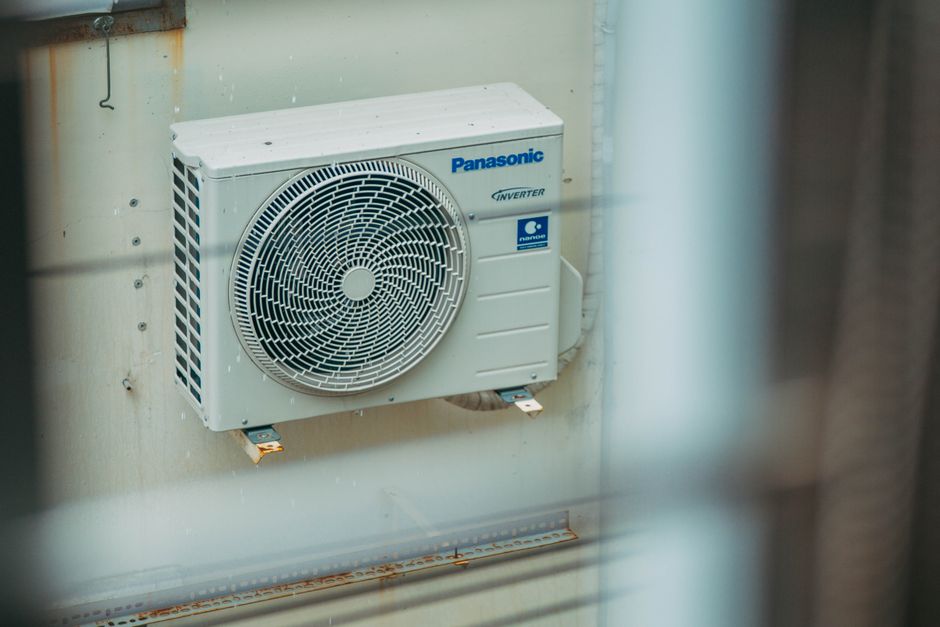
If you already have a central air conditioner and want to know its size, you do not have to guess. You can easily decode the tonnage directly from the outdoor condenser’s nameplate.
Walk outside and locate the metal specification label on your outdoor unit. Look for the model number (not the serial number). Within that model number, there will be a two-digit even number that represents the nominal BTU capacity in thousands.
Here is how to translate those capacity codes:
- 18 = 18,000 BTUs (1.5 tons)
- 24 = 24,000 BTUs (2 tons)
- 30 = 30,000 BTUs (2.5 tons)
- 36 = 36,000 BTUs (3 tons)
- 42 = 42,000 BTUs (3.5 tons)
- 48 = 48,000 BTUs (4 tons)
- 60 = 60,000 BTUs (5 tons)
For example, if your model number is something like “ASX160241,” the “24” indicates that you currently have a 2-ton system. Knowing this gives us a great baseline to evaluate whether your current system is sized correctly or if adjustments are needed for a replacement.
Step 2 & 3: Calculate Square Footage and Adjust for Environmental Factors

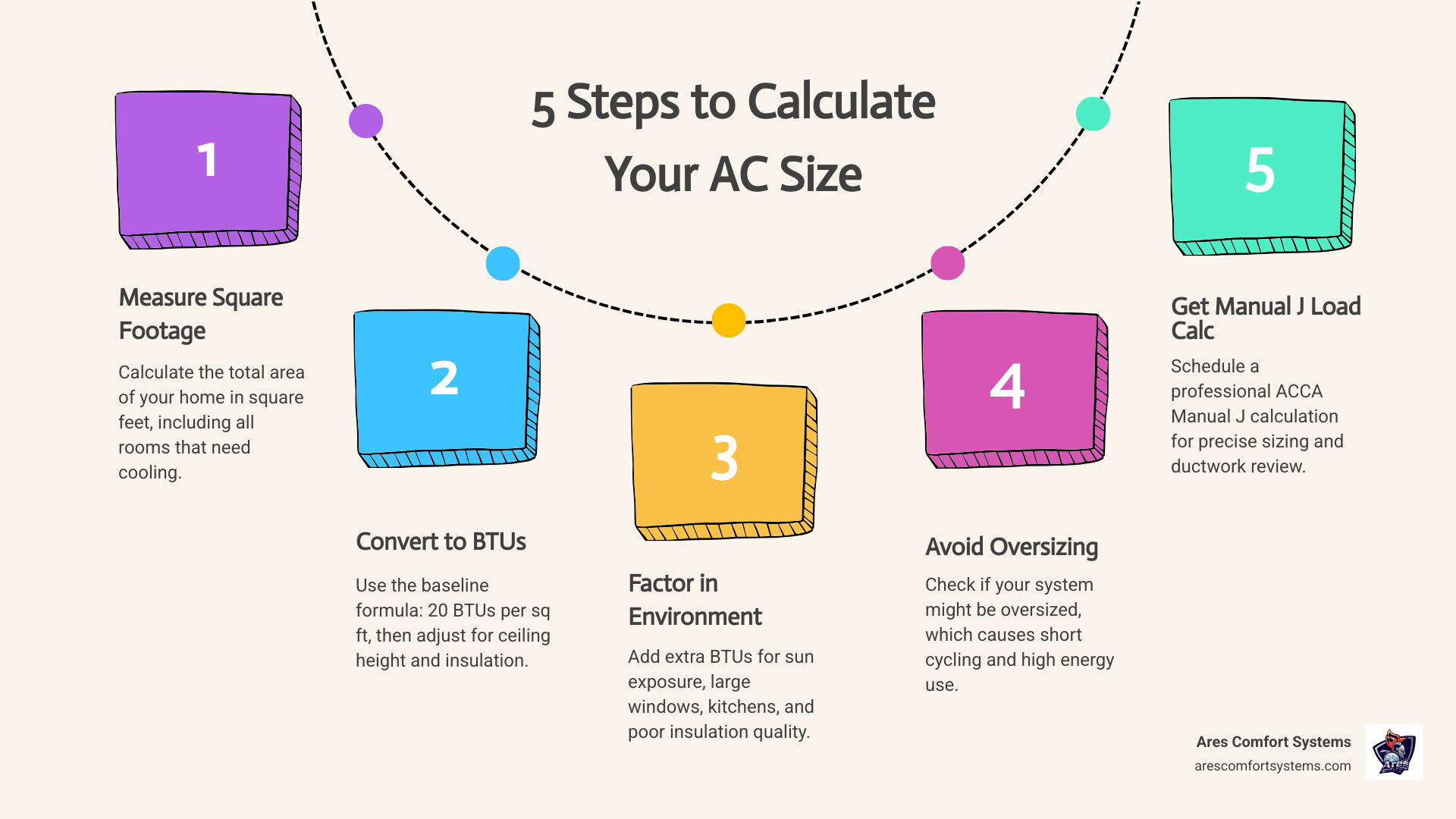
Now it is time to measure. To find your baseline cooling requirement, you must calculate the square footage of the air-conditioned living space.
For a single rectangular room, simply measure the length and width and multiply them together. If you are cooling multiple rooms, calculate the square footage of each space and add them together. For irregular layouts, divide the space into smaller rectangles, calculate the area of each, and sum the totals.
Once you have your total square footage, you can apply a baseline formula. In moderate climates, a standard rule of thumb is to allow 20 BTUs of cooling capacity for every square foot of living space.
However, a simple square footage calculation is only the starting point. Real-world homes are not empty boxes; several environmental factors will shift your actual BTU needs:
- Ceiling Height: Standard calculations assume an 8-foot ceiling. For every foot of ceiling height above 8 feet, you should add approximately 10% more cooling capacity to account for the increased volume of air.
- Sun Exposure: If a room is heavily shaded, you can reduce the required BTUs for that space by 10%. Conversely, if the room is highly sunny or features large south- or west-facing windows, add 10% to your calculation.
- Insulation Quality: Well-insulated homes retain cool air much better, meaning you can stay on the lower end of the BTU scale. Older homes with poor insulation or drafty windows will require more power to maintain comfortable temperatures.
- Climate Zones: In Western Washington—including King, Pierce, Thurston, and Kitsap Counties—our climate is generally mild, but we still experience summer heatwaves that demand reliable cooling.
- Kitchen Appliances: Kitchens generate significant heat. If you are sizing a system that cools a kitchen, add 4,000 BTUs to the total to counteract the heat from cooking appliances.
- Occupant Heat Load: People naturally generate body heat. Standard calculations account for two occupants. For every additional regular occupant in a space, add 600 BTUs to your target.
To help you visualize these calculations, we have put together a comprehensive resource on Size Matters: How to Calculate the Perfect HVAC for Your House as well as A Practical Guide to Picking the Best AC Unit for Your House to ensure you choose the best system type for your layout.
Here is a quick reference table showing how standard square footage aligns with recommended capacities before adjustments:
| Square Footage | Base BTU Requirement | Tonnage Equivalent |
|---|---|---|
| 1,000 – 1,200 sq ft | 24,000 BTUs | 2.0 Tons |
| 1,200 – 1,500 sq ft | 30,000 BTUs | 2.5 Tons |
| 1,500 – 2,000 sq ft | 36,000 BTUs | 3.0 Tons |
| 2,000 – 2,500 sq ft | 48,000 BTUs | 4.0 Tons |
| 2,500 – 3,000 sq ft | 60,000 BTUs | 5.0 Tons |
Step 4: Avoid the Pitfalls of Oversized or Undersized Systems
Many homeowners assume that buying a larger air conditioner is always better because it will cool the home faster. In reality, an oversized system is one of the most common and costly mistakes you can make.
When an air conditioner is too large for the space, it experiences a phenomenon called short-cycling. The system turns on, quickly blasts the home with cold air, and shuts off before completing a full cycle. This causes several severe problems:
- Poor Humidity Control: Air conditioners do more than cool the air; they also remove moisture. Dehumidification only occurs during longer, sustained cooling cycles. Short-cycling leaves your home feeling cold, damp, and clammy, which increases the risk of mold growth.
- Energy Waste: Starting up an AC unit requires a massive surge of electricity. Because an oversized unit turns on and off constantly, it consumes significantly more energy, leading to high utility bills.
- Premature Wear and Tear: Constant starting and stopping puts immense stress on the compressor and fan motor, leading to frequent breakdowns and shortening the overall lifespan of the system.
On the flip side, an undersized system comes with its own set of headaches. To understand the consequences of a system that is too small, read The Complete Guide to What Happens If Your HVAC Is Undersized.
In short, a small unit will run continuously without ever reaching your thermostat’s setpoint, driving up your energy bills and wearing out the components rapidly.
Step 5: Get a Professional Manual J Load Calculation
While online tables and quick calculations are excellent for getting a rough estimate, they should never replace a professional assessment. Before purchasing a new system, you should always request a Manual J load calculation.
Developed by the Air Conditioning Contractors of America (ACCA), the Manual J calculation is the industry-standard method for determining the exact heating and cooling loads of a home. Rather than relying solely on square footage, a Manual J calculation takes a highly scientific approach, analyzing:
- The exact R-value of your wall, floor, and attic insulation
- The orientation of your home relative to the sun
- The number, size, and U-factor of all windows and doors
- Local design temperatures for the Pacific Northwest
- Ductwork location, insulation, and potential leakage
- Heat gain from lighting, electronics, and major appliances
During this process, we also perform a thorough ductwork inspection. If your home’s air ducts are leaky, undersized, or poorly designed, even a perfectly sized AC unit will struggle to distribute air evenly.
Sizing your system accurately also allows you to maximize energy efficiency. Modern systems are rated using SEER2 (Seasonal Energy Efficiency Ratio 2). Selecting the correct tonnage first ensures that your high-efficiency SEER2 system actually delivers the utility savings it promises. To learn more about how system efficiency impacts your wallet over time, check out The Ultimate Guide to AC Repair vs New System Long-Term Savings.
Why a Manual J Calculation Solves: What Size Air Conditioner Do I Need?
A Manual J calculation removes all the guesswork. It guarantees that the equipment installed in your home is perfectly matched to its unique thermal characteristics.
By taking into account your home’s layout, airflow design, and local climate zones, a professional load calculation ensures balanced temperatures across every room, lower operating costs, and a system that will keep your family comfortable for decades to come.
Frequently Asked Questions About AC Sizing
How many square feet does a 2.5-ton AC unit cool?
A 2.5-ton air conditioner provides 30,000 BTUs of cooling capacity. In moderate climates like Western Washington, this size is typically sufficient to cool homes ranging from 1,200 to 1,500 square feet. However, if your home has vaulted ceilings, poor insulation, or large west-facing windows, a 2.5-ton unit might cover a slightly smaller footprint.
Does a higher SEER2 rating mean I need a different AC size?
No. SEER2 measures energy efficiency, not cooling capacity. A 3-ton AC unit will deliver 36,000 BTUs of cooling capacity whether it is a baseline 14.3 SEER2 system or a premium 20+ SEER2 system. However, the higher SEER2 unit will use significantly less electricity to deliver that same amount of cooling, saving you money on your monthly bills.
How do I calculate the square footage of an open floor plan?
For open floor plans, you must treat all adjoining spaces that are not separated by doors as a single zone. Measure the length and width of the entire open area—including the living room, dining room, and kitchen—and sum the square footage. Be sure to apply the 4,000 BTU adjustment if a kitchen is part of the open layout.
Conclusion
Calculating what size air conditioner do I need is the critical first step to achieving lasting home comfort and energy efficiency. While DIY formulas and charts are fantastic for giving you a general idea of your needs, the unique layout, insulation, and environmental factors of your home require a professional touch to get right.
At Ares Comfort Systems, we are dedicated to helping our neighbors throughout Western Washington stay cool and comfortable. Our team of experienced, licensed technicians (WA LIC # ARESCCS766CA) serves homeowners across King County, Pierce County, Thurston County, and Kitsap County. We back all of our work with a 100% satisfaction guarantee and our Fixed Right Promise.
Ready to find the perfect cooling system for your home? Contact us today to schedule a professional load calculation and explore our comfortable and efficient cooling services.