




How Many Tons of AC Do You Actually Need for Your Home?
If you’re wondering how many tons of AC do you need for your home, here’s a quick answer based on square footage:
| Home Size (Square Feet) | Recommended AC Size |
|---|---|
| Up to 900 sq ft | 1.5 tons (18,000 BTU) |
| 1,200 sq ft | 2 tons (24,000 BTU) |
| 1,500 sq ft | 2.5 tons (30,000 BTU) |
| 1,800 sq ft | 3 tons (36,000 BTU) |
| 2,100 sq ft | 3.5 tons (42,000 BTU) |
| 2,400 sq ft | 4 tons (48,000 BTU) |
| 3,000 sq ft | 5 tons (60,000 BTU) |
Note: These are starting estimates. Your actual needs depend on your climate, insulation, windows, ceiling height, and other factors. A professional load calculation gives you the most accurate answer.
Picking the right AC size is one of the most important decisions you’ll make for your home’s comfort. Go too small, and your system runs nonstop trying to keep up. Go too big, and you end up with a home that feels cool but clammy — and a unit that wears out faster than it should.
This guide walks you through everything you need to know: what “tons” actually means, how to estimate the right size for your home, what factors change that number, and why a professional load calculation is the only way to get it exactly right.
What “AC Tons” Actually Mean
When we talk about AC tonnage, we aren’t talking about how much the unit weighs on a scale. You don’t need to worry about your air conditioner falling through the floor! In the HVAC world, a “ton” is a measurement of cooling capacity.
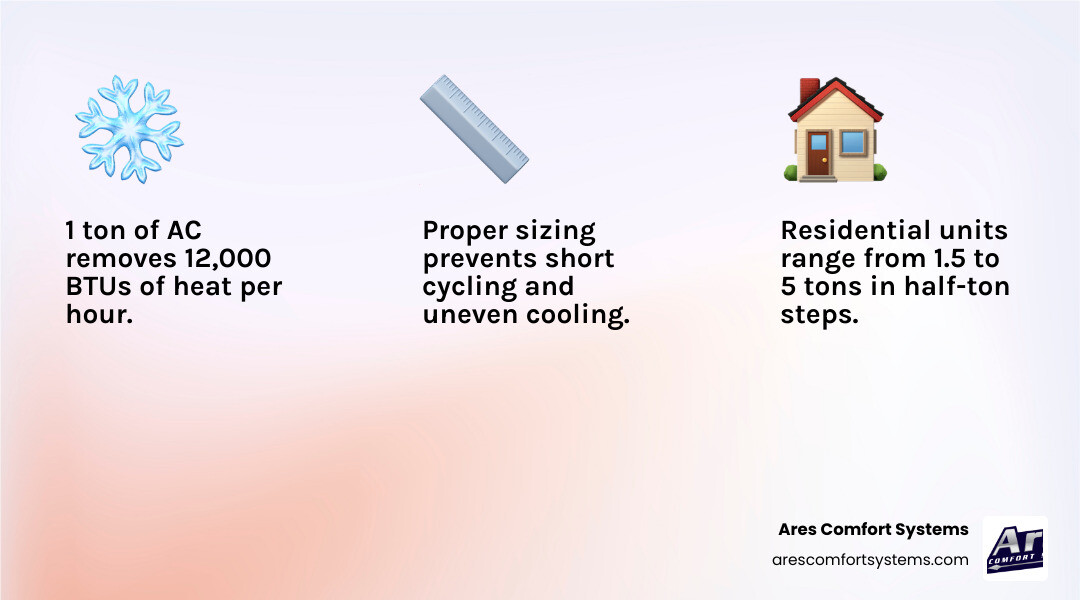
Specifically, it refers to the amount of heat an air conditioning unit can remove from your home in one hour. Residential AC units typically range from 1.5 tons up to 5 tons, usually increasing in half-ton increments.
How many tons of AC do i need for my home, and what does a ton mean?
If you are asking how many tons of AC do i need for my home, you are really asking about your home’s “heat load.” One ton of cooling capacity is equal to 12,000 BTUs (British Thermal Units) per hour. This terminology actually dates back to the days before modern refrigeration, when people used literal tons of ice to cool buildings. One “ton” of AC provides the same amount of cooling as melting one ton of ice over a 24-hour period.
BTUs vs. tons: the simple conversion homeowners should know
Understanding the relationship between BTUs and tons is the first step to becoming a savvy HVAC shopper. BTUh stands for British Thermal Units per Hour. To find the tonnage of a system when you only have the BTU rating, simply divide by 12,000.
- 18,000 BTU / 12,000 = 1.5 Tons
- 24,000 BTU / 12,000 = 2 Tons
- 36,000 BTU / 12,000 = 3 Tons
- 48,000 BTU / 12,000 = 4 Tons
- 60,000 BTU / 12,000 = 5 Tons
Why Proper AC Sizing Matters More Than Most Homeowners Think
It’s tempting to think that “bigger is better” when it comes to staying cool during a King County heatwave, but an oversized unit can be just as problematic as one that’s too small. We like to call this the “Goldilocks Principle”—you want a system that is just right.
What happens if your AC is too big?
If a unit is too large for the space, it will reach the target temperature on your thermostat very quickly and then shut off. This is called “short cycling.” While it might sound efficient, it’s actually a disaster for your comfort and your wallet.
Because the unit doesn’t run long enough, it never gets the chance to remove humidity from the air. You end up with a home that is “cool but sticky.” Furthermore, the constant starting and stopping puts massive wear and tear on the compressor, leading to a shorter lifespan and higher energy bills.
What happens if your AC is too small?
An undersized unit is like a marathon runner who hasn’t trained—it will struggle constantly. It will run all day and night without ever reaching your desired temperature, especially on those rare 90-degree days in Washington. This leads to hot spots in certain rooms, astronomical electricity use, and a system that burns out years earlier than it should because it never gets a break.
How many tons of AC do i need for my home if I want better efficiency and comfort?
To achieve the best balance of humidity control and energy efficiency, you need a right-sized system. When a unit is properly sized, it runs for long enough cycles to pull moisture out of the air, leaving your home crisp and comfortable. If you’re ready to find that perfect fit, our team can help with professional Air Conditioning Services.
How to Estimate How Many Tons of AC You Need for Your Home
While a professional assessment is always best, you can get a “ballpark” idea using some simple math.
Start with square footage: a quick AC tonnage formula
A common rule of thumb is that you need about 20 BTUs for every square foot of living space.
- Calculate BTUs: Square Footage x 20.
- Convert to Tons: Divide that number by 12,000.
For example, if you have a 2,000 sq. ft. home: 2,000 x 20 = 40,000 BTUs. Dividing 40,000 by 12,000 gives you 3.33 tons. Since units come in half-ton increments, you’d likely look at a 3.5-ton unit.
Rough AC tonnage chart for common home sizes
Here is how those “rules of thumb” generally play out for standard homes:
| Square Footage | Estimated Tonnage |
|---|---|
| 900 | 1.5 Tons |
| 1,500 | 2.5 Tons |
| 1,800 | 3 Tons |
| 2,400 | 4 Tons |
| 3,000 | 5 Tons |
Example calculations for 1,500, 2,000, and 3,000 square foot homes
- 1,500 sq. ft.: Usually requires a 2.5-ton unit. This is a very common size for many suburban homes in Pierce and Thurston Counties.
- 2,000 sq. ft.: Typically falls between 3 and 4 tons. If the home is older with original windows, it might lean toward 4 tons; if it’s a newer build, 3 tons might be plenty.
- 3,000 sq. ft.: Generally requires a 5-ton unit, which is the largest standard residential size. In very large homes, we often recommend two separate smaller units to better manage different “zones” of the house.
How many tons of AC do i need for my home based on square footage alone?
While square footage is a great starting point, asking how many tons of AC do i need for my home based only on floor space can be risky. Modern homes with high-performance insulation might only need 1 ton for every 1,000 square feet, whereas an older, drafty home might need 1 ton for every 400 square feet.
The Factors That Change AC Size Beyond Square Footage
Several variables can shift your tonnage needs up or down.
Climate zone and location: why Washington homes may size differently
Homes in the Pacific Northwest have different needs than those in Arizona. We deal with moderate summers but higher humidity. Because our “design temperature” (the average peak heat we expect) is lower than in the desert, we can often use slightly smaller units than a homeowner in a hotter climate would for the same size house.
Home features that can raise or lower your cooling load
- Insulation: Better insulation (R-value) keeps the cool air in, allowing for a smaller unit.
- Windows: Large, south-facing windows act like giant heaters. If you have lots of glass, you’ll need more tonnage.
- Ceiling Height: Standard math assumes 8-foot ceilings. If you have vaulted or 10-foot ceilings, you have more air volume to cool, which can increase your needs by 10-25%.
- Occupancy: Every person in the home generates about 200-300 BTUs of heat. A house with six people needs more cooling than a house with two.
Ductwork, airflow, and system design still affect tonnage
Your AC is only as good as the ducts carrying the air. We generally look for 400 CFM (Cubic Feet per Minute) of airflow for every ton of cooling. If your ductwork is too small or leaky, a 5-ton unit will never actually perform like one.
Central air vs. ductless sizing considerations
If you live in an older home without existing ducts, you might consider Going Ductless for the Whole House: A Sizing Guide for Homeowners. Ductless mini-splits are sized differently because they cool individual zones. You can learn more about whether a Mini-Split Better Than Central Air for Your Wallet and Comfort? or explore Adding Cooling to a Home Without Ductwork: Options and Ideas.
Why a Manual J Load Calculation Is the Best Way to Size an AC
If you want to move past “rules of thumb” and get scientific, you need a Manual J load calculation. This is the industry-standard protocol for precisely calculating exactly how much heat your home gains throughout the day.
What a Manual J calculation includes
A professional Manual J takes into account:
- The exact square footage of every room.
- The orientation of the house (which side gets the afternoon sun).
- The type and thickness of insulation in the walls and attic.
- The number and type of windows (single-pane vs. double-pane).
- Local climate data for the Puget Sound region.
Why you should not size a new AC based only on the old one
Many homeowners assume they should just buy the same size as their old unit. However, if you’ve replaced windows, added insulation, or finished a basement since that old unit was installed, your home’s cooling needs have changed. Additionally, the original unit might have been sized incorrectly from the start!
When replacing your AC, how to make sure the new system is properly sized
When it’s time for an AC Installation, we always perform a thorough assessment. Whether you are looking for AC Replacement in Puyallup WA or Puyallup Central AC Replacement, we ensure the math is done right before a single bolt is turned.
Choosing the Right Unit After You Know the Size
Once you know the tonnage, you still have to choose the type of unit.
What SEER2 rating should you consider?
SEER2 (Seasonal Energy Efficiency Ratio) measures how much cooling the unit delivers per watt of electricity used. In 2026, modern units typically range from 13.4 to over 20 SEER2. While a higher SEER2 unit doesn’t change the tonnage you need, it does change how much you’ll pay to run that tonnage.
Does higher efficiency change the tonnage you need?
No. A 3-ton unit with a 14 SEER2 rating provides the same amount of cooling as a 3-ton unit with a 20 SEER2 rating. The difference is that the 20 SEER2 unit does the work using much less electricity.
Single-stage vs. two-stage vs. variable-speed systems
- Single-Stage: Like a light switch—it’s either 100% on or 100% off.
- Two-Stage: Has a “high” and “low” setting. It runs on low most of the time to save energy and provide better dehumidification.
- Variable-Speed: The most efficient option. It can adjust its output to any percentage to perfectly match your home’s needs.
Check out our guide on Single-Stage vs Two-Stage AC Systems for a deeper dive.
How to find the tonnage of your current AC unit
Look at the data plate on your outdoor condenser. Find the model number (not the serial number). Look for a two-digit even number in the middle of that string:
- 18 = 1.5 Tons
- 24 = 2 Tons
- 30 = 2.5 Tons
- 36 = 3 Tons
- 42 = 3.5 Tons
- 48 = 4 Tons
- 60 = 5 Tons
Signs it may be time to replace your AC
If your unit is over 12–15 years old, requires frequent repairs, or if your energy bills are spiking, it might be time for an upgrade. If you’re looking for Lakewood’s Finest AC Installers, we are here to help.
Frequently Asked Questions About How Many Tons of AC Do You Need?
Is 1 ton of AC enough for 600 square feet?
In many cases, yes. However, if that 600 square feet is a sunroom with all-glass walls and no insulation, you might need more.
Can a newer, better-insulated home need fewer tons?
Absolutely. Modern “tight” homes are so efficient that they often require significantly less tonnage than older homes of the same size.
Should a large home use one big AC or a zoned setup?
For homes over 3,000 square feet, we often recommend two smaller units or a zoned system. This prevents the “upstairs is hot, downstairs is freezing” syndrome.
Conclusion
Getting the tonnage right is the difference between a home that is truly comfortable and one that is just “less hot.” At Ares Comfort Systems, we combine decades of experience with precise Manual J calculations to ensure your new system is sized perfectly for your specific home and the unique Washington climate.
Ready to stay cool? Contact us today for expert Air Conditioning Services and let us help you find your “Goldilocks” fit.