


Why Knowing What Size HVAC System Do I Need Could Save You Thousands
What size HVAC system do I need is one of the most important questions you can ask before buying or replacing a heating and cooling unit. Get it right, and your home stays comfortable year-round while your energy bills stay low. Get it wrong, and you’re looking at a system that breaks down early, leaves rooms clammy and uneven, and runs up utility costs month after month.
Here’s a quick answer based on your home’s square footage:
| Home Size (sq ft) | Recommended Capacity | BTUs per Hour |
|---|---|---|
| 600 – 1,000 | 1.5 tons | 18,000 BTU |
| 1,000 – 1,200 | 2 tons | 24,000 BTU |
| 1,200 – 1,500 | 2.5 tons | 30,000 BTU |
| 1,500 – 2,000 | 2.5 – 3 tons | 30,000 – 36,000 BTU |
| 2,000 – 2,500 | 3 – 3.5 tons | 36,000 – 42,000 BTU |
| 2,500 – 3,000 | 4 – 5 tons | 48,000 – 60,000 BTU |
Important: These are starting estimates only. Your actual needs depend on insulation quality, ceiling height, window efficiency, climate, and more — especially here in Western Washington.
That said, square footage alone doesn’t tell the whole story. Research consistently shows that up to 90% of HVAC systems are improperly sized or installed — a staggering number that leads to real problems for real homeowners every day.
In this guide, we’ll walk you through exactly how to calculate the right size HVAC system for your home — from understanding BTUs and tonnage, to the industry-standard Manual J load calculation, to the specific factors that matter most for homes in King, Pierce, Thurston, and Kitsap Counties.
Why the Question “What Size HVAC System Do I Need” Is Critical for Your Home
When we talk to homeowners in Lakewood or Tacoma, we often find they believe “bigger is better.” They assume a 5-ton unit will cool a house faster than a 3-ton unit. In reality, an oversized system is just as problematic as an undersized one. Proper sizing is the baseline for everything else we do, from a routine HVAC Inspection to long-term HVAC Maintenance.
If your system is too large, it will engage in “short-cycling.” This means the unit blasts cold or hot air, reaches the thermostat setting in minutes, and then shuts off. Because it doesn’t run long enough to move air through the entire house or remove moisture, you end up with a home that feels like a humid cave. If it’s too small, it will run 24/7, struggling to keep up with a Washington summer afternoon, leading to a massive spike in your utility bills and a compressor that burns out years before its time.
The consequences of improper sizing
Installing the wrong capacity leads to a domino effect of home comfort issues:
- Equipment Wear: Frequent starting and stopping (short-cycling) is the hardest thing you can do to an HVAC motor. It’s like driving your car in stop-and-go traffic for 15 years straight.
- Clammy Air: Air conditioners don’t just cool; they dehumidify. If the cycle is too short, the water vapor never has a chance to condense and drain away, leaving your skin feeling sticky.
- High Utility Bills: Systems use the most electricity during the startup phase. An oversized unit that starts 10 times an hour is an energy hog.
- Uneven Temperatures: You might have a freezing living room but a sweltering master bedroom because the air didn’t circulate long enough to reach the far corners of the house.
Single-stage vs. two-stage performance
When determining what size hvac system do i need, you should also consider how the unit operates.
- Single-stage units are either 100% on or 100% off. These are the most sensitive to sizing errors.
- Two-stage units (and variable-speed models) can modulate. They might run at 65% capacity on a mild day and kick into 100% only when it’s truly freezing or scorching outside.
- Heat Pumps often utilize this staged technology to provide highly efficient heating and cooling, making them a popular choice for the temperate climate of the Puget Sound region.
Understanding HVAC Capacity: BTUs and Tonnage Explained
To answer “what size hvac system do i need,” you have to speak the language of the industry. HVAC systems are measured in BTUs (British Thermal Units) and Tonnage.
A BTU is the amount of energy needed to raise the temperature of one pound of water by one degree Fahrenheit. In HVAC terms, it measures how much heat a system can move in an hour. Tonnage does not refer to the weight of the unit. Historically, it represented the cooling power of a one-ton block of ice melting over 24 hours.
The math is simple: 1 Ton = 12,000 BTUs per hour.
Most residential systems range from 1.5 tons (18,000 BTUs) to 5 tons (60,000 BTUs). If your home requires more than 5 tons, we usually recommend installing multiple systems or looking into Mini Splits to handle specific zones.
Decoding your current unit’s model number
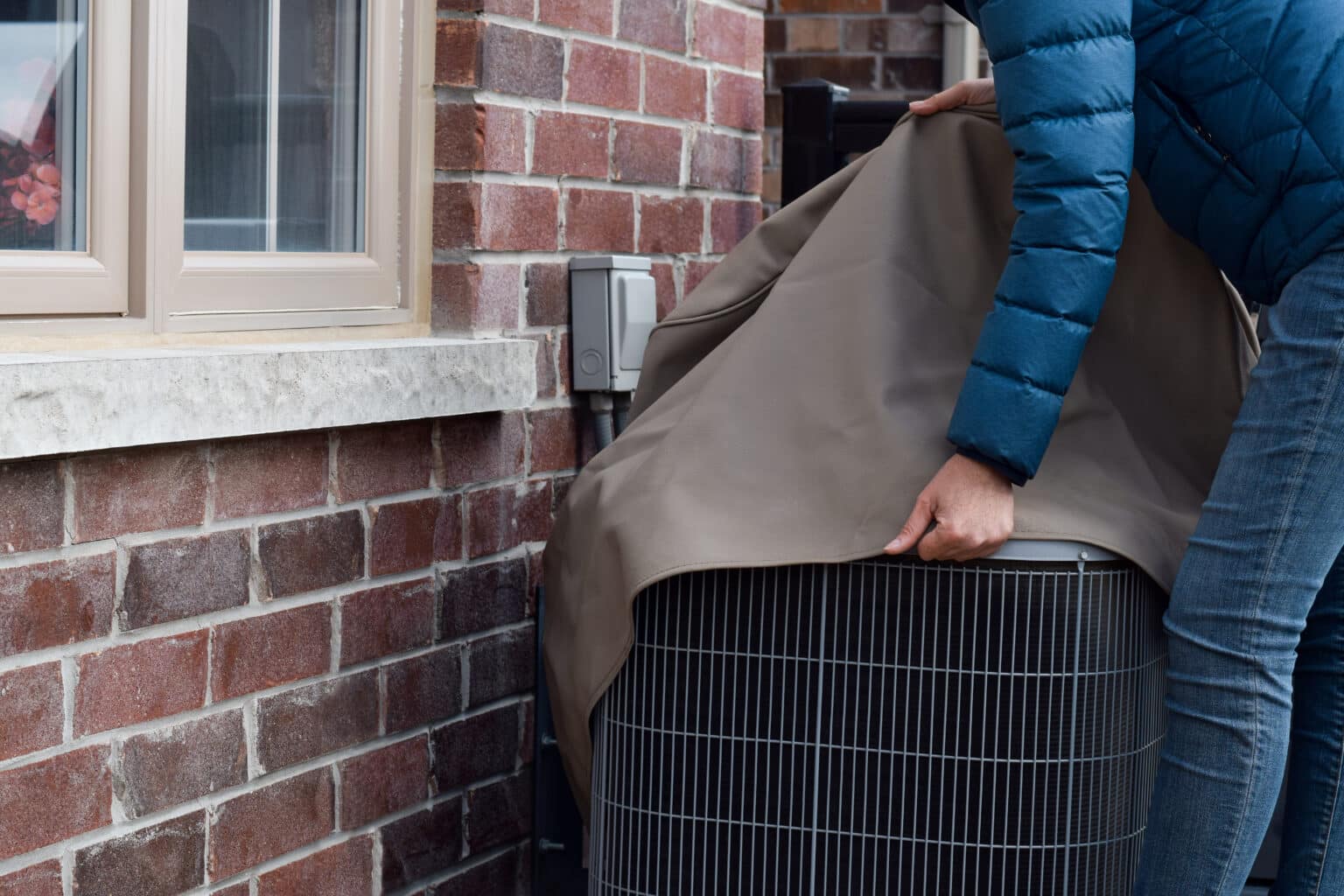
Want to know what you currently have? You don’t need to find the original paperwork. Go outside and look at the sticker on your compressor (the outdoor unit). Look for the model number (not the serial number).
Somewhere in that string of letters and numbers, you’ll see a two-digit number divisible by 6 or 12.
- 18 = 1.5 Tons
- 24 = 2 Tons
- 30 = 2.5 Tons
- 36 = 3 Tons
- 42 = 3.5 Tons
- 48 = 4 Tons
- 60 = 5 Tons
If you see “36” in your model number, you have a 3-ton unit. Knowing this is a great starting point when considering AC Replacement in Puyallup WA: A Complete Guide to Staying Cool.
How to Estimate Your Needs Based on Square Footage
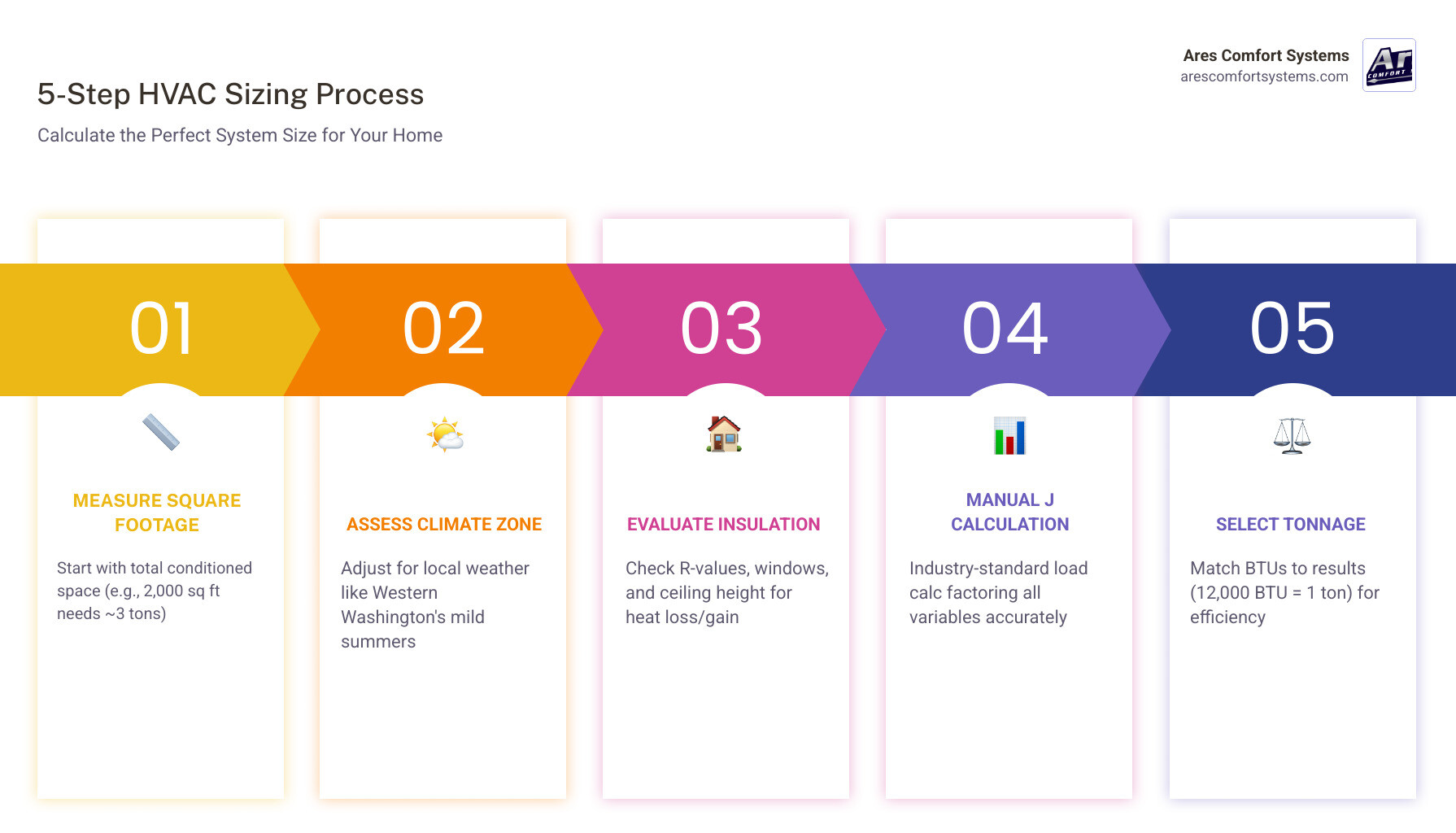
A common “rule of thumb” is that you need about 20 to 25 BTUs for every square foot of living space. However, this is just a rough estimate. Modern homes with high-efficiency insulation might only need 15 BTUs per square foot, while an older, drafty home in King County might need 30.
| Square Footage | Estimated Tonnage | BTU Capacity |
|---|---|---|
| 1,200 sq ft | 2.0 Tons | 24,000 BTU |
| 1,500 sq ft | 2.5 Tons | 30,000 BTU |
| 2,000 sq ft | 3.0 Tons | 36,000 BTU |
| 3,000 sq ft | 5.0 Tons | 60,000 BTU |
For those looking at alternative setups, Ductless ACs are often sized room-by-room, which can be more accurate than a single whole-house estimate.
What size HVAC system do I need for a 2,000 sq ft home?
For a standard 2,000-square-foot home in the Pacific Northwest, a 3-ton capacity (36,000 BTUs) is the most common starting point. However, we have to adjust for our unique regional factors. Does your home have giant south-facing windows that catch the afternoon sun? You might need a bit more cooling. Is your home tucked under the shade of Douglas firs? You might get away with a slightly smaller unit. When performing Puyallup Central AC Replacement: The Core of Home Comfort, we look at these nuances to ensure the system is perfect for your specific lot.
Beyond Square Footage: The Manual J Load Calculation
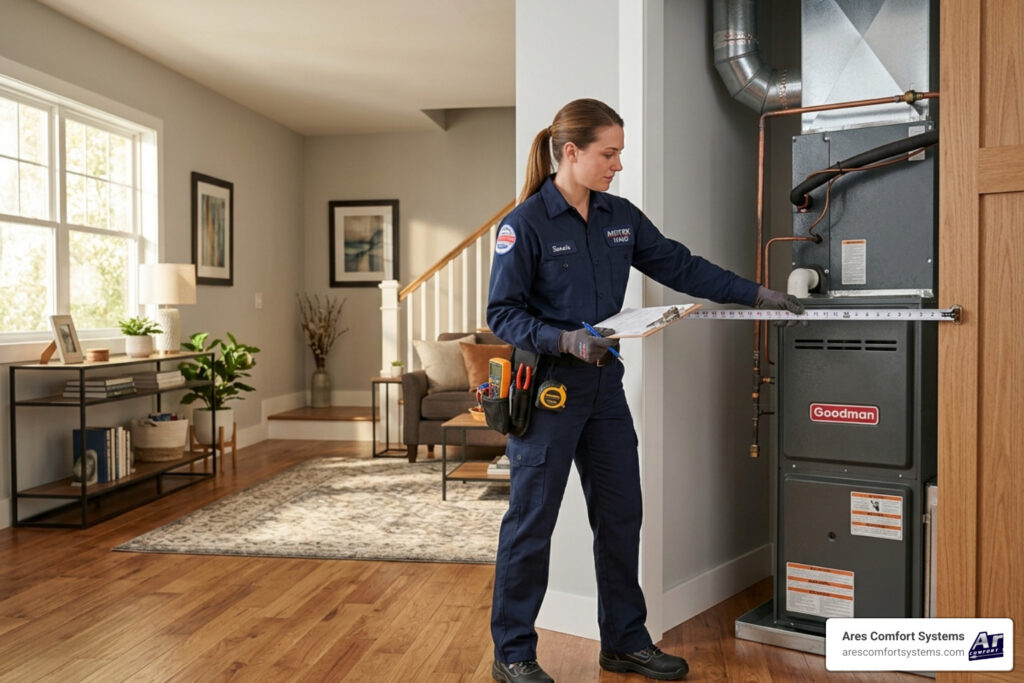
If a contractor walks into your home, looks at your square footage, and gives you a quote immediately, be careful. They are guessing. To truly answer what size hvac system do i need, professionals use the Manual J Load Calculation.
This is the industry-standard protocol developed by the Air Conditioning Contractors of America (ACCA). It is a scientific method that accounts for every variable that gains or loses heat in your home. It’s the difference between buying a suit off the rack and having one custom-tailored. This level of precision is especially vital when Going Ductless for the Whole House: A Sizing Guide for Homeowners.
Factors that answer what size HVAC system do I need in Washington
When we perform a load calculation in Pierce or Thurston County, we look at:
- Ceiling Height: A room with 12-foot vaulted ceilings has much more air volume to treat than a room with 8-foot ceilings, even if the square footage is the same.
- Insulation R-Value: We check your attic and walls. High-quality insulation acts like a thermos, allowing you to use a smaller, more efficient HVAC unit.
- Window Efficiency: Are they single-pane or double-pane? Do they have Low-E coatings? Windows are the biggest source of heat gain in the summer.
- Occupancy Levels: Each person in your home generates about 250–400 BTUs of heat per hour. A family of six needs more cooling than a couple.
- Heat-Generating Appliances: Computers, large TVs, and high-end ovens all add to the “heat load” of the house.
The role of ductwork and airflow
Even the perfectly sized unit will fail if your “lungs” (the ductwork) are too small. We follow the Manual D standard for duct design. A general rule is that you need 400 CFM (Cubic Feet per Minute) of airflow for every ton of cooling. If you try to push 4 tons of air through 2 tons of ductwork, you’ll face high static pressure, loud whistling noises, and a blower motor that will burn out prematurely.
Signs Your Current System Is the Wrong Size
Not sure if your current system is the right fit? Look for these red flags:
- Frequent Cycling: If your unit turns on and off every 5 to 10 minutes, it’s likely oversized.
- Constant Operation: If the unit runs all day without a break and the house still feels warm, it’s likely undersized.
- Excessive Noise: A system that is too big for its ducts will sound like a jet engine taking off in your hallway.
- High Indoor Humidity: If your home feels “sticky” or “clammy” even when the air is cold, the system isn’t running long enough to remove moisture.
Frequently Asked Questions about HVAC Sizing
How many BTUs per square foot are needed for cooling?
In our region, 20 BTUs per square foot is the standard baseline. However, for well-insulated modern homes, this can drop to 15 BTUs, while older homes with poor insulation may require up to 30 BTUs per square foot.
Is a bigger HVAC unit always better for my house?
No. An oversized unit is one of the most common causes of high energy bills and premature system failure. It leads to short-cycling, which prevents dehumidification and increases wear on the motor.
Can I use my old ductwork with a new, larger unit?
Only if the ductwork was originally oversized. In most cases, if you increase the tonnage of your HVAC system, you must also increase the size of your ducts to handle the higher airflow (CFM) requirements.
Conclusion
Choosing the right HVAC size isn’t just a technicality—it’s the foundation of your home’s comfort and your financial peace of mind. At Ares Comfort Systems, we bring decades of experience to every home in Lakewood, King County, and beyond. We don’t believe in “rule of thumb” guesswork. We rely on scientific load calculations to ensure your new system fits your home perfectly.
Whether you need a new installation or a system evaluation, we back our work with a 100% Satisfaction Guarantee and our Fixed Right Promise. Don’t leave your comfort to chance or a rough estimate.
Schedule your expert HVAC sizing consultation today and let us help you find the perfect fit for your Washington home.