



Why Understanding How Leaky Ducts Waste Energy and Money Can Save You Hundreds Each Year
How leaky ducts waste energy and money is one of the most overlooked problems in homes across King, Pierce, Thurston, and Kitsap Counties in Washington State. Most homeowners assume their HVAC system is the main driver of high utility bills — but the ductwork hidden in your attic, crawlspace, or walls is often the real culprit.
Here is a quick summary of the core issue:
| What Happens | The Impact |
|---|---|
| Conditioned air escapes through gaps, cracks, and loose joints | 20–30% of heated or cooled air never reaches your living space |
| HVAC system runs longer to compensate | Energy bills climb — by hundreds of dollars per year |
| Leaks in unconditioned spaces (attics, crawlspaces) add thermal loss on top of air loss | Total heating/cooling energy waste can reach up to 40% |
| System works 50% harder with just 20% air loss | Equipment wears out faster, raising repair and replacement costs |
| Unsealed return ducts pull in unfiltered air | Indoor air quality drops; dust, mold, and allergens increase |
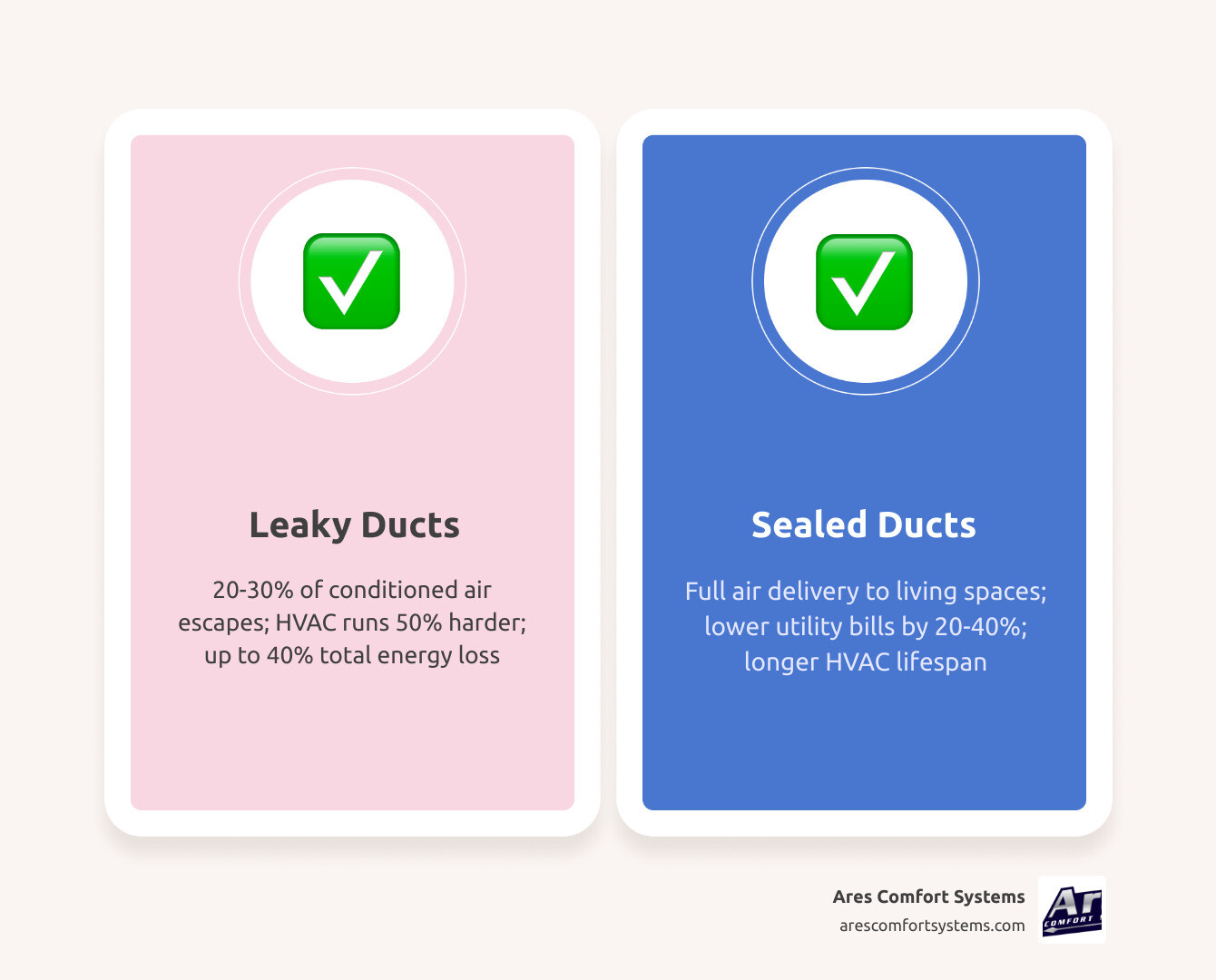
Think of it like a bucket full of holes. Your HVAC works hard to fill the bucket — but a significant portion of what it produces leaks out before it ever reaches you. The U.S. Department of Energy estimates that most homes lose between 20% and 30% of conditioned air this way. In some cases, total energy losses climb even higher.
For homeowners in the Puget Sound region, where heating demands are real and energy costs matter, this is not a small problem. It is a quiet, ongoing drain on your comfort and your wallet — month after month, season after season.
The good news? It is a fixable problem. But first, it helps to understand exactly how and where the energy is escaping.
The Hidden Cost: How Leaky Ducts Waste Energy and Money
When we talk about how leaky ducts waste energy and money, we aren’t just talking about a few cents here and there. Industry data shows that typical duct systems lose up to 40% of heating or cooling energy through leaks. For a homeowner in Lakewood or King County, this translates to hundreds of dollars in wasted utility payments every single year.
The math is sobering. If your ducts are leaking just 20% of your conditioned air, your HVAC system has to work 50% harder to maintain the temperature set on your thermostat. This isn’t just inefficient; it’s expensive. By addressing these leaks, homeowners can realistically cut their heating and cooling costs by 20% to 40%.
To help you visualize the difference, we’ve put together a comparison of how energy is delivered in a standard leaky home versus one that has been professionally sealed. You can learn more about Maximizing Energy Efficiency in Your Washington Home to see how these improvements fit into your overall home performance.
Energy Delivery Comparison
| Feature | Leaky System (Typical) | Sealed System (Optimized) |
|---|---|---|
| Air Delivery | ~70% reaches living space | ~97% reaches living space |
| System Efficiency | 60% – 70% overall | 83% – 95% overall |
| Annual Wasted Cost | $200 – $800 | Near $0 |
| HVAC Workload | High (Runs longer cycles) | Normal (Standard cycles) |
How Leaky Ducts Waste Energy and Money in Unconditioned Spaces
The location of your ductwork plays a massive role in how much energy is lost. In many Washington homes, ducts run through “unconditioned” spaces—areas that aren’t heated or cooled, like attics, crawlspaces, or garages.
When a supply duct leaks in a freezing attic during a Pierce County winter, that expensive heated air is dumped directly outside. Conversely, if a return duct leaks in a damp crawlspace, it pulls in cold, moist air that your furnace then has to work twice as hard to heat. Furthermore, even if the ducts aren’t leaking air, “thermal conduction” allows heat to escape through the thin walls of the metal or plastic tubing. This is why proper Air Duct Installation and insulation (at least R-8 for unconditioned spaces) are vital for stopping the drain on your bank account.
How Leaky Ducts Waste Energy and Money by Reducing System Lifespan
Beyond the monthly bill, there is a long-term financial hit: the early death of your HVAC equipment. A furnace or heat pump designed to last 15 to 20 years might fail after only 10 or 12 years if it is constantly struggling against leaky ducts.
The mechanical strain of running 50% harder leads to more frequent breakdowns, frozen evaporator coils, and burnt-out blower motors. We often see that The Importance of Regular HVAC Maintenance includes checking the integrity of the distribution system, because even the most expensive high-efficiency furnace becomes a “budget-buster” if the air it produces never reaches your bedroom.
Identifying the Warning Signs of Duct Leakage
How do you know if your home is suffering? Since most ductwork is hidden behind drywall or under floors, you have to look for the “symptoms.” One of the most common signs is a home that feels “unbalanced.” Do you have one room that is always freezing in the winter while the rest of the house is cozy? This is often a sign of a disconnected or heavily leaking duct branch.
Other warning signs include:
- Sky-high utility bills: If your energy costs have spiked but your habits haven’t changed, the air is likely escaping.
- Excessive dust: If you find yourself dusting every two days, your return ducts might be pulling in dirt from your crawlspace.
- Whistling or rattling: Unusual noises when the air turns on can indicate air escaping through a narrow crack under high pressure.
- Visible gaps or old tape: If you can see your ducts, look for sections that have separated or for old, dried-out silver duct tape that is peeling off.
For a deeper dive into these symptoms, check out our guide on How to Tell if Your Ductwork is Leaking Air and Money.
The Impact on Indoor Air Quality and Household Health
The way how leaky ducts waste energy and money is only half the story. The other half involves your health. When ducts leak, they don’t just let air out; they let “bad stuff” in.
Leaky return ducts create negative pressure, essentially acting like a vacuum that sucks in air from the dirtiest parts of your home. This can include:
- Allergens and Pollutants: Dust, insulation fibers, and outdoor pollen.
- Moisture and Mold: Damp air from crawlspaces can lead to mold growth inside your vents, which is then blown into your living areas.
- Pests: Rodents and insects can enter through holes in the ductwork, leaving behind droppings and debris.
- Safety Risks: Perhaps most importantly, leaky ducts can cause “backdrafting.” This is when the pressure imbalance pulls combustion gases (like carbon monoxide) from water heaters or furnaces back into the house instead of venting them safely outside.
Regular HVAC Maintenance is the best way to ensure your system is pressurized correctly and your air remains clean and safe for your family.
Professional Sealing Methods vs. DIY Fixes
Many homeowners’ first instinct is to grab a roll of standard silver “duct tape.” Ironically, standard duct tape is actually the worst thing you can use! The adhesive dries out quickly due to the heat of the system, and the tape will fail within months.
The DIY Approach
If you are handy, you can perform minor repairs on visible ductwork.
- What to use: Use UL-181 rated foil tape or, better yet, duct mastic. Mastic is a thick, gooey paste that you apply with a brush. It dries into a flexible, permanent seal.
- What to avoid: Never use cloth-backed “duck” tape. It isn’t rated for heat and is not a permanent solution.
The Professional Advantage
While DIY can fix a visible hole, most leaks are hidden. At Ares Comfort Systems, we use advanced tools to ensure a 100% seal.
- Duct Blaster Testing: We use a specialized fan and pressure gauge to measure exactly how much air your system is losing.
- Thermal Imaging: We use infrared cameras to “see” where hot or cold air is escaping behind your walls.
- Aeroseal Technology: For leaks that can’t be reached by hand, aerosolized sealants can be blown through the system to seal holes from the inside out.
- R-8 Insulation: We ensure ducts in unconditioned spaces are wrapped in high-quality insulation to stop conductive heat loss.
Frequently Asked Questions about Leaky Ducts
How much conditioned air do leaky ducts typically lose?
On average, most homes lose between 20% and 30% of their conditioned air through leaks. In older homes or systems with poor installation, that number can climb as high as 40%. This is essentially like leaving a window wide open all year round.
Can I use standard silver duct tape for permanent repairs?
Absolutely not. Despite the name, standard duct tape is not meant for HVAC ducts. The rubber-based adhesive breaks down when exposed to the temperature fluctuations of a heating system. Always look for UL-181 rated foil-backed tape or duct mastic sealant for a repair that actually lasts.
How often should ductwork be inspected in Western Washington?
We recommend a professional duct inspection every 3 to 5 years. However, if you live in an older home in King or Pierce County, or if you’ve recently had issues with rodents in your crawlspace, you should have them checked sooner to ensure your energy efficiency hasn’t been compromised.
Conclusion
Understanding how leaky ducts waste energy and money is the first step toward a more comfortable and affordable home. Whether you are in Lakewood, Tacoma, or anywhere across King, Pierce, Thurston, and Kitsap Counties, your ductwork is the “veins and arteries” of your home’s comfort system. When they leak, your wallet feels the pain.
At Ares Comfort Systems, we are dedicated to helping our neighbors stay cozy while keeping utility costs down. With our “Fixed Right Promise” and decades of experience, we can identify hidden leaks and provide lasting solutions that pay for themselves in energy savings.
Don’t let your hard-earned money vanish into your attic. Schedule your professional air duct installation or sealing today and start breathing easier—and spending less.