



Is Your Ductwork Leaking Air and Money in the Puget Sound?
How to know if your ductwork is leaking is something every homeowner in King, Pierce, Thurston, and Kitsap Counties should understand — especially when hidden leaks can quietly drive up energy bills and kill comfort year-round.
Quick answer — the most common signs your ductwork is leaking:
- Uneven room temperatures — some rooms are too hot or too cold no matter what you set the thermostat to
- Higher-than-normal energy bills — your HVAC runs longer but delivers less comfort
- Excessive dust buildup — especially near vents and registers
- Weak airflow from supply vents in certain rooms
- Whistling or hissing sounds coming from the duct system when your HVAC is running
- Musty or stale odors — a sign that air is being pulled in from attics or crawlspaces
- Insulation particles on your air filter — a red flag that return ducts are leaking
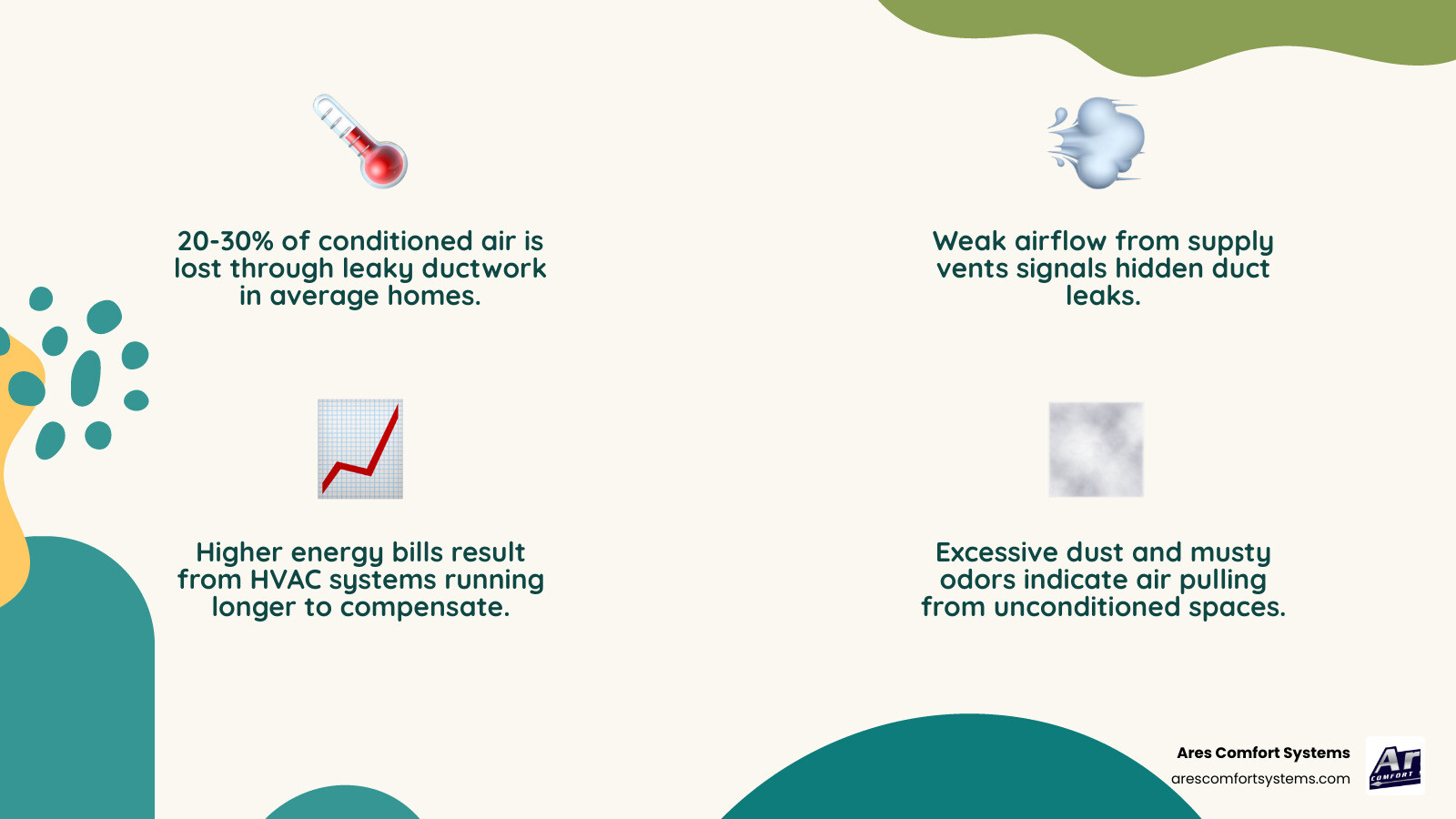
Here’s why this matters: according to the U.S. Department of Energy, the average home loses 20–30% of its conditioned air through leaky, poorly sealed, or disconnected ductwork. That’s not a small inefficiency — that’s like paying to heat or cool a room you never use, every single month.
In the Pacific Northwest, where we rely heavily on heat pumps and forced-air systems to stay comfortable through cold winters and warm summers, leaky ducts put extra strain on your equipment and hit your wallet harder than most homeowners realize.
The good news? Many of the warning signs are ones you can spot yourself — and once you know what to look for, you can take action before the problem gets worse.
Common Signs Your HVAC System is Losing Conditioned Air in King County
Living in the Puget Sound area, we deal with a unique climate that demands a lot from our heating and cooling systems. Whether it’s a damp April 2026 morning in Lakewood or a rare summer heatwave in King County, your ductwork is the “highway” that delivers comfort. When that highway has potholes, your comfort escapes into your attic, crawlspace, or walls.
One of the most frustrating symptoms of leaky ducts is inconsistent comfort. You might find yourself wondering Why Your House is Still Hot even when the AC is cranking. If your primary bedroom feels like a sauna while the living room is a walk-in freezer, the air intended for the bedroom is likely leaking out long before it reaches the vent.
Keep an eye out for these specific red flags:
- Excessive Dust: Do you feel like you’re dusting your furniture every other day? Leaky return ducts can pull in fine particulate matter, insulation fibers, and allergens from unconditioned spaces like your attic or crawlspace. This bypasses your filtration system and blows directly into your living areas. This is a major factor when looking at How to Improve Indoor Air Quality.
- Whistling, Hissing, or Rattling: Your HVAC system shouldn’t sound like a haunted house. If you hear Strange Noises from Your AC Unit, specifically hissing or whistling near the walls or ceiling, it’s often air escaping through a narrow gap or a loose joint in the metalwork.
- Sky-High Utility Bills: If your energy bills are creeping up but your usage hasn’t changed, your system is likely working overtime to compensate for the 20-30% of air it’s losing. This is one of the classic Signs Your Air Conditioner Needs Repair.
- Musty Odors: When air is pulled from a damp crawlspace into your return ducts, it brings those “old basement” smells with it. If you notice a funky scent every time the furnace kicks on, you likely have a leak in a return line.
How to know if your ductwork is leaking via airflow
A simple way to test your system is to perform a register check. Turn your HVAC system to “Fan On” or “Cool” so the blower is running at full speed. Walk through every room in your house and place your hand over the supply registers.
If you notice that airflow is significantly weaker in rooms furthest from the air handler, or if some registers are barely blowing at all, you are likely dealing with disconnected joints or major tears in the ductwork. This creates a pressure imbalance where the system “pushes” air into the attic instead of your bedroom. If you find these “dead zones,” it’s time to look into professional HVAC Repairs to restore the balance of your home.
The Impact of Leaky Ducts on Your Washington Home’s Efficiency
We often talk to homeowners in Pierce and Thurston Counties who are shocked to learn how much money is “slipping through the cracks.” To put it in perspective, losing 30% of your conditioned air is like buying a gallon of milk and pouring three cups down the drain as soon as you get home.
| Feature | Well-Sealed Ductwork | Leaky Ductwork |
|---|---|---|
| Air Delivery | 95-100% reaches the rooms | 70-80% reaches the rooms |
| Energy Waste | Minimal | 20-30% loss (DOE Stats) |
| HVAC Strain | Low; cycles normally | High; runs longer cycles |
| Air Quality | High (filtered air) | Low (pulls dust from attics) |
| Equipment Life | Extended | Shortened due to overwork |
When your ducts leak, your furnace or heat pump has to work much harder to reach the temperature set on your thermostat. This constant “overtime” leads to premature wear and tear. By addressing these leaks, you are Maximizing Energy Efficiency in Your Washington Home and protecting your investment.
Furthermore, leaky ducts have a negative environmental impact. Higher energy consumption means a larger carbon footprint for your household. Sealing your ducts is one of the most cost-effective ways to “go green” without replacing your entire HVAC system.
How to Know if Your Ductwork is Leaking: DIY Inspection Steps
If you’re feeling handy, you can perform a preliminary HVAC Inspection yourself. Most ductwork in Western Washington is located in attics, basements, or crawlspaces.
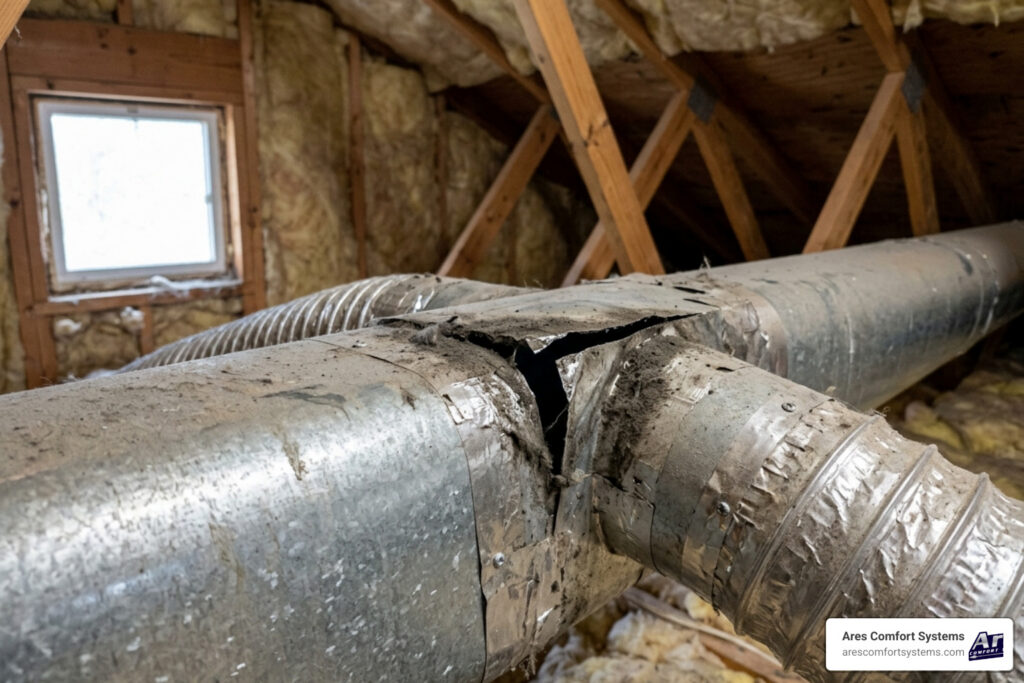
- The Visual Check: Grab a bright flashlight and head into your attic or crawlspace. Look for obvious disconnections where two pieces of metal or flexible ducting have pulled apart.
- Look for “Duct Tape”: Ironically, standard “duck” tape or silver cloth tape is terrible for ducts. It dries out and peels off over time. If you see old, shriveled tape hanging off your joints, that’s a guaranteed leak site.
- The “Dirty Insulation” Tell: This is a pro tip. Insulation acts like a filter. If you see fiberglass insulation that looks dark or discolored near a duct joint, it means air has been blowing through it, leaving dust and dirt behind. It’s essentially a “smoke trail” of a leak.
- The Hand-Feel Test: While the system is running, carefully move your hand along the seams and joints of the exposed ductwork. If you feel a concentrated “breeze” hitting your skin, you’ve found a hole.
Regularly performing these checks is a great part of your overall HVAC Maintenance routine.
How to know if your ductwork is leaking using the smoke test
For smaller leaks that you can’t feel with your hand, the “smoke test” is a classic DIY method. You can use an incense stick or a dedicated “smoke pencil” (which produces a safe, visible vapor).
- Light the incense and hold it near a duct joint or seam while the HVAC blower is running.
- Watch the smoke trail. If the smoke suddenly wavers, gets sucked into a crack, or gets blown away violently, you’ve identified a leak.
- Pro Tip: Use a grease pencil or a piece of brightly colored tape to mark these spots. It’s easy to forget where the tiny holes were once you turn the system off to start repairs.
While you can use UL-181 rated foil tape or duct mastic for temporary DIY fixes, these are often just “band-aids.” For a comprehensive solution, we recommend scheduling AC Maintenance Services to have a professional evaluate the entire system.
Professional Solutions for Sealing and Repairing Ductwork in the Puget Sound
Sometimes, DIY methods aren’t enough—especially when leaks are hidden inside walls or in hard-to-reach corners of a Kitsap County crawlspace. At Ares Comfort Systems, we utilize advanced technology to ensure your home is airtight.
- Aeroseal Technology: This is a game-changer for Washington homeowners. Instead of trying to find every tiny crack by hand, Aeroseal puts pressurized, non-toxic sealant particles into your duct system. These particles stay suspended in the air until they find a leak, where they cling to the edges and build up a permanent seal. It’s like a “liquid patch” for your entire duct highway.
- Duct Blaster Test: This is the “lie detector test” for your HVAC. We seal all your registers and use a specialized fan to pressurize the system. A computer then measures exactly how much air is escaping, giving us a precise percentage of leakage.
- Duct Replacement: In older homes around King and Pierce Counties, we often find original ductwork that is simply too far gone. If your ducts are rusted, crushed, or made of outdated materials, a full Air Duct Installation is the better long-term investment.
- Insulation Upgrades: Even if your ducts aren’t “leaking” air, they might be leaking heat. We ensure all ducts in unconditioned spaces are wrapped in high-R-value insulation to prevent your furnace from losing its “punch” before the air reaches your living room.
Whether you need AC Repairs or Heating Repairs, addressing the ductwork is often the missing piece of the puzzle.
Long-Term Benefits of Addressing Ductwork Issues
Taking the time to fix your ducts isn’t just about stopping a whistling noise; it’s about transforming how your home feels and functions.
- Lower Utility Bills: When you stop heating the attic, your bills go down. Many homeowners see a return on their investment in just a few seasons.
- Consistent Comfort: No more “hot rooms” or “cold spots.” Every room gets the air it was designed to receive.
- Improved Indoor Air Quality (IAQ): By sealing out the dust, mold spores, and insulation fibers from your crawlspace, you can breathe easier. This is The Importance of Regular HVAC Maintenance in action.
- Extended Equipment Life: Your HVAC system will cycle less frequently and run for shorter durations, meaning fewer breakdowns and a longer lifespan for your furnace or heat pump.
- Noise Reduction: Properly sealed and balanced ducts operate much more quietly, eliminating those annoying hisses and rattles.
If your home’s layout makes traditional ductwork difficult to manage, you might also consider comparing Mini-Split vs. Central Air or looking into Adding Cooling Without Ductwork.
Frequently Asked Questions about Leaky Ducts
Can I use standard duct tape to fix leaks?
No! Despite the name, standard grey “duct tape” is not designed for HVAC ducts. The adhesive dries out quickly when exposed to the temperature fluctuations of a heating system. Within months, the tape will peel off. Always use UL-181 rated foil-backed tape or duct mastic (a thick, paintable sealant).
How often should I have my ductwork inspected?
We recommend a professional duct inspection every 3 to 5 years, or sooner if you notice signs like sudden bill spikes or excessive dust. In the Puget Sound, where we have high humidity, checking for mold or moisture in the ducts is also a wise move during your annual tune-up.
Will sealing my ducts really lower my energy bills?
Yes. The U.S. Department of Energy estimates that sealing and insulating ducts can save the average homeowner up to $140 or more per year in energy costs. In larger homes or those with significant damage, the savings can be even more dramatic.
Stop Paying to Heat Your Attic
If you’ve noticed any of the signs we discussed — from the “mystery dust” to the “sauna bedroom” — don’t wait for your HVAC system to break down under the strain. How to know if your ductwork is leaking is the first step; the second step is calling in the experts.
At Ares Comfort Systems, we’ve spent decades helping our neighbors in Lakewood, King County, Pierce County, Thurston County, and Kitsap County stay comfortable. Our work is backed by a 100% satisfaction guarantee and our Fixed Right Promise. We don’t just patch holes; we optimize your entire home’s airflow.
Ready to see how much you could be saving? Contact us today for an inspection or to learn more about our Air Duct Installation services. (WA LIC # ARESCCS766CA)