


Why Your AC Is Running But Not Cooling — And What to Check Right Now
If you’re dealing with ac not cooling properly what to check is probably the first thing on your mind — and we’ll get straight to it.
Here are the most common things to check first:
- Thermostat settings — Make sure it’s set to “Cool,” not “Fan Only,” and the temperature is set below the current room temperature
- Air filter — A clogged filter is the #1 cause of poor cooling; check and replace it if it’s grey and dusty
- Circuit breaker — A tripped breaker can cut power to the outdoor unit while the indoor fan still runs
- Outdoor condenser unit — Check for debris, overgrown plants, or dirt blocking the coils
- Vents and registers — Make sure none are closed, blocked by furniture, or obstructed
- Frozen evaporator coils — Look for ice on the refrigerant lines near your indoor unit
- Outdoor unit running — Walk outside and confirm the fan is spinning and the unit is actually on
Most of the time, your AC isn’t broken — it’s struggling. Something small is making it work harder than it should. A dirty filter, a blocked condenser, or even a thermostat set to the wrong mode can leave you sweating through a hot afternoon wondering what went wrong.
The good news is that many of these issues are quick to spot and easy to fix yourself. Others need a licensed technician. This guide walks you through both — so you can stop guessing and start cooling down.
AC Not Cooling Properly: What to Check First
When the mercury rises in Pierce or King County, the last thing you want is a home that feels like a sauna. If you are wondering about your ac not cooling properly what to check, the very first stop on your mystery tour should be the thermostat. It sounds simple, but you’d be surprised how often a “broken” AC is just a thermostat that was bumped or set incorrectly.
Thermostat Settings and Power
First, verify that your thermostat is set to “Cool” mode. If it’s on “Heat” or “Off,” you’re going to be disappointed. Next, check the fan setting. It should be on “Auto,” not “On.” When the fan is set to “On,” it blows air through your house 24/7, even when the cooling cycle isn’t running. This results in warm air blowing out of your vents between cooling cycles, making the house feel humid and stagnant.
If the display is blank, it might just need new batteries. Most modern thermostats require AA or AAA batteries to communicate with your HVAC system. If the batteries are fresh and the settings are correct, but the outdoor unit isn’t humming, head to your electrical panel. Air conditioners pull a lot of juice, and a power surge—common during Washington summer storms—can trip a breaker. If you find a tripped breaker, reset it once. If it trips again immediately, stop and call for Air Conditioning Services. Repeated tripping usually points to a failing capacitor or a grounded compressor.
The 18-Degree Rule
How do you know if your AC is actually underperforming or if it’s just a record-breaking heatwave? Use the “18-degree rule.” A healthy air conditioner should produce air that is roughly 18 to 20 degrees Fahrenheit cooler than the air entering the return vent. If your home is 78 degrees and the air coming out of the register is 60 degrees, your unit is likely doing its job, but the heat load on your house (sunlight, poor insulation, or open windows) is simply too high.
Troubleshooting Airflow and Outdoor Unit Issues
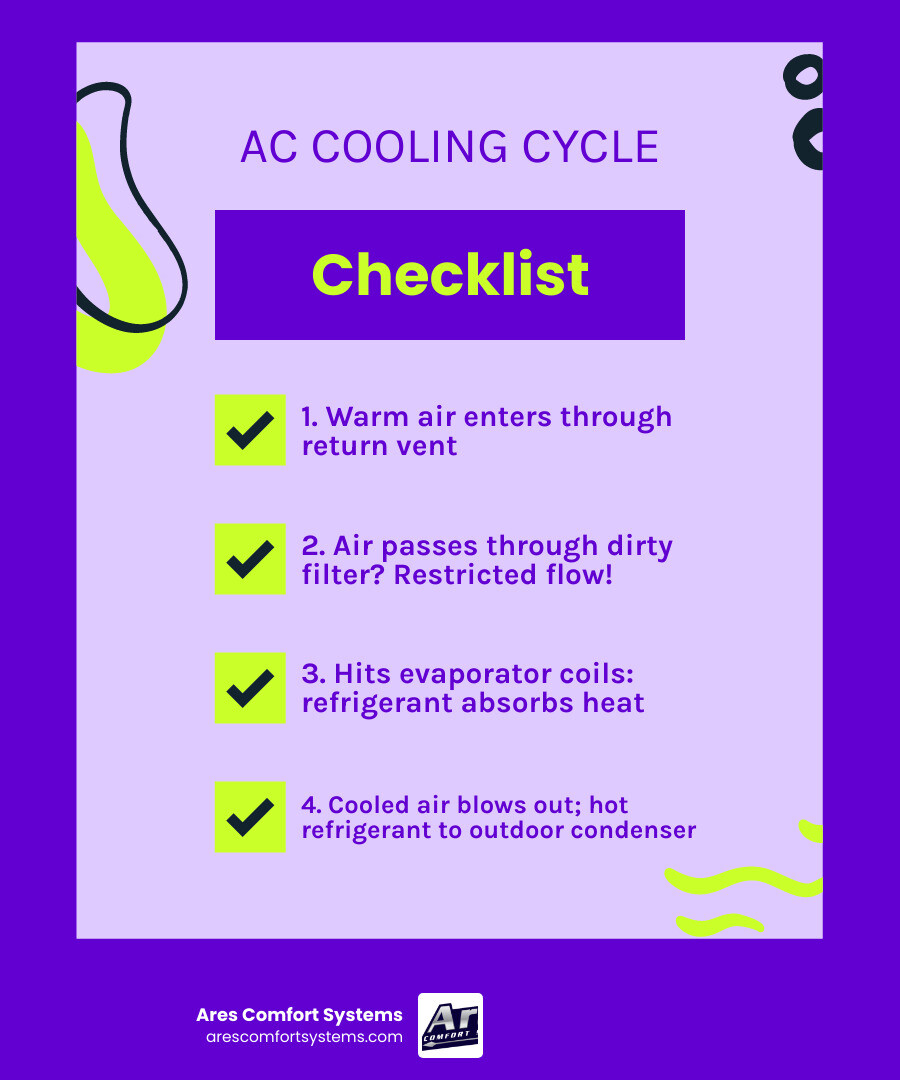
Airflow is the lifeblood of your cooling system. If the air can’t move, the heat can’t leave. When investigating ac not cooling properly what to check next, look at your filters and your outdoor unit.
The Air Filter: The Silent Performance Killer
A dirty air filter is the number one reason for AC Maintenance Services calls. When the filter is clogged with dust, pet hair, or wildfire smoke (a common issue in Thurston and Kitsap Counties), the blower motor has to work twice as hard to pull air through. This restricted airflow can cause the internal components to overheat or, ironically, cause the system to freeze up. Check your filter; if you can’t see light through it, it’s time for a change.
The Outdoor Condenser Unit
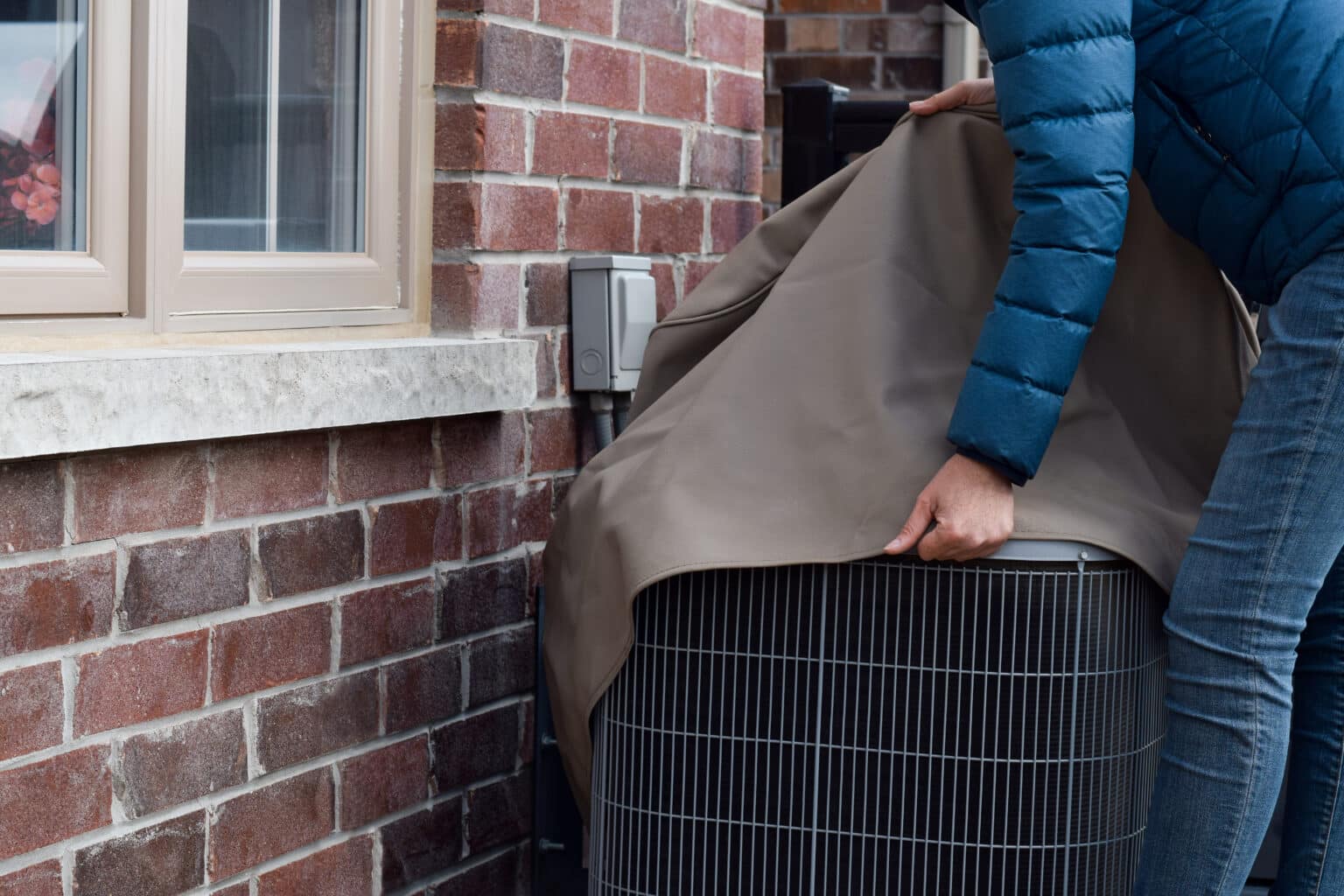
Your outdoor unit is responsible for releasing the heat collected from inside your home. If the metal fins (coils) are covered in dirt, grass clippings, or spider webs, that heat stays trapped. We recommend the “2-foot rule”: keep at least two feet of clear space around the entire unit. Trim back shrubs, move trash cans, and ensure there aren’t any tall weeds choking the intake.
You can gently rinse the coils with a garden hose (never use a pressure washer, as it will flatten the delicate aluminum fins), but for a deep clean, professional help is usually safer.
| Feature | DIY Filter Cleaning/Replacement | Professional Coil Deep-Cleaning |
|---|---|---|
| Frequency | Every 1–3 months | Once a year (Spring) |
| Difficulty | Easy | Advanced |
| Impact | Improves airflow & indoor air quality | Boosts efficiency & prevents compressor failure |
| Tools Needed | Just the replacement filter | Coil cleaner, fin comb, specialized vacuum |
Lastly, check your indoor registers. It’s a myth that closing vents in unused rooms saves money. In reality, it increases pressure in the ductwork and can lead to leaks or a frozen system. Ensure all vents are open and unobstructed by furniture or rugs.
Identifying Complex Mechanical Failures
If the simple checks don’t solve the problem, we have to look deeper into the mechanical heart of the machine. Air conditioners are complex, and as they age, parts naturally wear out. Most central AC units have a lifespan of 10 to 15 years. If yours is pushing the upper limit of that range, it may be time to consult our AC Replacement in Puyallup WA: A Complete Guide to Staying Cool.
Signs of Frozen Evaporator Coils
One of the most confusing symptoms of ac not cooling properly what to check is finding ice on your unit in the middle of a 90-degree day. This happens when the evaporator coil (the part inside your home) gets too cold because it isn’t absorbing enough heat. This is usually caused by:
- A severely clogged air filter.
- Blocked return vents.
- Low refrigerant levels.
If you see ice on the copper lines or frost on the indoor cabinet, turn the AC off immediately. Set the thermostat fan to “On” to help thaw the ice, but do not run the cooling cycle. Running a frozen AC can cause liquid refrigerant to flood back into the compressor, which is a recipe for an expensive HVAC Inspection and even more expensive repairs.
Refrigerant Leaks: The Hissing Truth
Your AC doesn’t “use up” refrigerant like a car uses gas. It circulates it in a closed loop. If you are low on refrigerant, you have a leak. Signs of a leak include a faint hissing sound near the indoor or outdoor units, ice on the coils, and a house that stays humid despite the AC running.
Because of EPA regulations, homeowners cannot buy or add refrigerant themselves. If you suspect a leak, you need AC Repairs from a licensed technician who can find the hole, seal it, and “recharge” the system to the manufacturer’s specifications.
Capacitor and Compressor Health
If you hear a clicking or humming sound from the outdoor unit but the fan isn’t spinning, you might have a blown capacitor. Think of the capacitor as a giant battery that gives the motor the “kick” it needs to start. These are common HVAC Repairs that are relatively quick to fix but dangerous to attempt yourself due to the high electrical charge they hold.
When DIY Troubleshooting Isn’t Enough
Sometimes, the problem isn’t a broken part; it’s the design of the system itself. If your AC has always struggled to keep up on the hottest days, it might be undersized. Air conditioners are measured in BTUh (British Thermal Units per hour). If your home has had an addition, or if the original installer didn’t account for Washington’s high-vaulted ceilings and large windows, the unit will simply never be able to reach your target temperature.
In these cases, AC Installation of a more powerful unit or adding a supplemental system is the only permanent fix. Additionally, leaky ductwork in your attic or crawlspace could be “cooling the squirrels” instead of your living room. If your ducts are disconnected or uninsulated, you could be losing up to 30% of your cooling capacity before the air even reaches the vent.
The Importance of Regular HVAC Maintenance cannot be overstated. A system that is cleaned and calibrated annually is far less likely to suffer from these mid-summer meltdowns.
Frequently Asked Questions about AC Troubleshooting
Should I turn off my AC if it is running but not cooling?
Yes, absolutely. If the unit is running but the air isn’t cold, the compressor is likely straining or overheating. Continuing to run a malfunctioning system can turn a simple repair—like a dirty coil or a bad capacitor—into a total system failure. You are also wasting a significant amount of electricity for zero comfort. Turn it off at the thermostat and call a pro.
How often should I replace my air filter to prevent cooling issues?
In the Pacific Northwest, we recommend checking your filter every 30 days and replacing it at least every 90 days. However, if you have pets, live near a construction site, or during wildfire season, you may need to change it every month. High MERV-rated filters catch more particles but also restrict airflow more quickly, so keep a close eye on them. For more specific advice, check out these Expert Tips for Maintaining Your Puyallup Split System AC.
What is the difference between central AC and ductless cooling issues?
While the refrigeration cycle is the same, Ductless ACs (mini-splits) often have different maintenance needs. They don’t have large duct networks to leak, but they do have individual filters in each indoor head that must be cleaned monthly. Ductless systems are also prone to clogged condensate drain lines, which can cause water to leak down your interior walls if not cleared regularly.
Conclusion
At Ares Comfort Systems, we know that a hot house leads to short tempers. Whether you’ve discovered a simple tripped breaker or you’re facing a more complex refrigerant issue, we are here to help. We serve families across Lakewood, King County, Pierce County, and beyond with our “Fixed Right Promise” and a 100% satisfaction guarantee.
Don’t spend another night tossing and turning in the heat. If your DIY checks didn’t do the trick, it’s time for professional AC Repairs. Contact us today to learn more about our Comfort Service Agreements and how we can keep your home a sanctuary of cool all summer long.