
My AC Keeps Breaking Down in the Puget Sound. Should I Repair It or Replace It?
When weighing ac repair vs new system long term savings, the right answer depends on a few key factors: your system’s age, how often it breaks down, and how much energy it’s wasting every month.
Here’s a quick summary to help you decide:
| Situation | Best Choice |
|---|---|
| System is under 10 years old, minor issue | Repair |
| Repair is a major investment compared to replacement | Replace |
| Age and repair history point to ongoing reliability issues | Replace |
| System is 10-15+ years old with frequent breakdowns | Replace |
| Rising energy bills, low SEER rating | Replace |
| Single component failure, system in good shape | Repair |
Your air conditioner is one of the hardest-working appliances in your home — especially during the warm months across King, Pierce, Thurston, and Kitsap Counties in Washington State. When it starts struggling, you’re immediately faced with a tough call: schedule a repair now, or invest in a new system that could deliver better efficiency, reliability, and comfort over time.
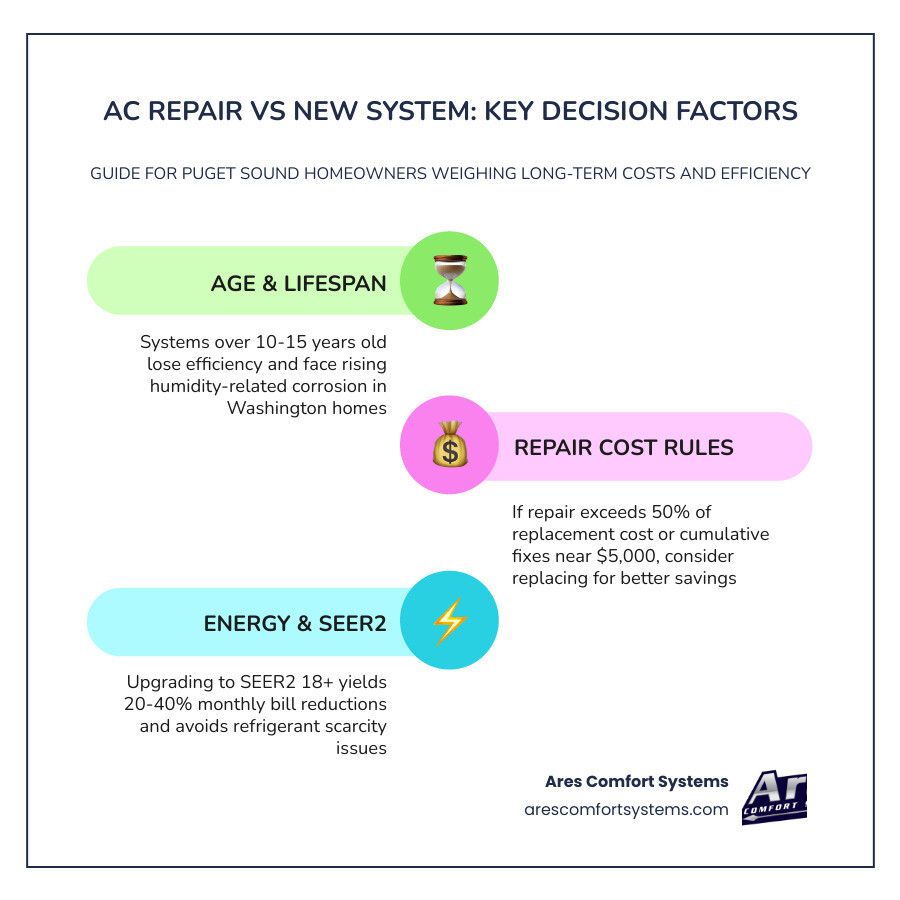
Most central AC units last between 10 and 15 years. As they age, they lose efficiency, break down more often, and can become more expensive to operate. At some point, fixing an old system stops making practical sense — and that’s exactly what this guide is here to help you figure out.
Is My AC Too Old? Understanding Lifespan in the Puget Sound
In our corner of the Pacific Northwest, we often expect our appliances to last forever. However, the reality is that most central air conditioning systems are designed to last between 10 and 15 years. While a well-maintained unit in Lakewood or Tacoma might stretch toward the 20-year mark, it’s often doing so at the cost of your comfort and your wallet.
As your system enters its second decade, the internal components face significant wear and tear. In Washington, our humidity can take a toll on evaporator coils, leading to corrosion and refrigerant leaks. Even if the machine is still “running,” its performance naturally declines. You might notice it takes longer to cool the house, or it never quite reaches the temperature set on the thermostat. To get a better sense of how long your specific setup should last, check out our guide on The Long and Short of How Long Your HVAC System Really Lasts.
Signs of System Aging in King County
Living in King County means dealing with varying temperatures that can put a strain on older equipment. Keep an eye out for these “red flags” that suggest your AC is nearing the end of its life:
- Uneven Cooling: One bedroom feels like an ice box while the living room is sweltering.
- Strange Noises: Banging, screeching, or grinding sounds often indicate a failing compressor or motor.
- Frequent Cycling: The system turns on and off constantly, struggling to maintain a steady temperature.
- Dust Accumulation: Older systems often lose their ability to filter air effectively, leading to more dust throughout your home.
The Long-Term Value of AC Repair vs New System Replacement
When we talk to homeowners in Pierce and Thurston Counties, we always suggest taking the emotion out of the decision and looking at the bigger picture. A repair may be the right move for a newer system with an isolated issue, but repeated breakdowns on an older unit often point to replacement as the better long-term solution.
One helpful rule of thumb is to look at the overall condition of the system. If your AC is older, needs frequent service, and is no longer cooling reliably, replacement is often the smarter path. On the other hand, if the issue is minor and the rest of the system is in good shape, a professional repair may restore performance and extend its life. For more help with this decision, see our article on When to Replace Your AC Instead of Repairing It.
Calculating AC Repair vs New System Long Term Savings with SEER2
The real “magic” of a new system is found in the efficiency ratings. As of May 2026, the industry has fully embraced the SEER2 standard. If you are upgrading from an old 10 SEER unit to a modern SEER2 18 system, you could see a noticeable reduction in your cooling bills.
Newer high-efficiency systems can lower monthly cooling demand compared to units from just a decade ago. Over time, many homeowners find that better efficiency, improved comfort, and fewer repair headaches make upgrading well worth it. You can learn more about Maximizing Energy Efficiency in Your Washington Home to see how these ratings impact your specific utility bills.
When Frequent Fixes Become a Sunk Cost
We call it the “repair spiral.” It starts with a small capacitor fix. The next year, it’s a fan motor. Soon after, you’re dealing with refrigerant issues. These “cascading failures” are a sign that the system’s major components are failing one by one. Not only does that mean more service visits, but it can also leave you without reliable cooling when you need it most. Reliability has a value all its own.
Modern Refrigerants and Regulatory Impacts on Your Decision
One of the biggest factors in ac repair vs new system long term savings is something you can’t even see: the refrigerant. If your system was installed before 2010, it likely uses R-22 (Freon). The EPA banned the production and import of R-22 years ago, making it increasingly difficult to source.

Even systems using R-410A (the standard for the last 15 years) are now seeing a “phase-down” under the EPA AIM Act. As of 2026, the industry is transitioning to newer, more environmentally friendly alternatives like R-454B.
Why Servicing Older Units is Getting More Difficult
As supply for older refrigerants tightens, it becomes harder to keep some aging systems running efficiently. If your older unit has a leak, you aren’t just dealing with the repair itself; you’re also working with an outdated refrigerant that is becoming less practical to use over time. Upgrading to a modern system can help you avoid that headache and keep your home aligned with current environmental standards.
Maximizing Incentives and Planning Your Upgrade
The good news for Washington homeowners is that there has never been a better time to invest in a new system. Thanks to the Inflation Reduction Act, the 25C tax credit allows you to claim up to $2,000 for qualifying heat pumps or $600 for high-efficiency central AC units.
When you combine federal tax credits with local utility rebates from providers in the Puget Sound area, the overall value of a new system improves significantly. For a deeper dive into local options, check out our AC Replacement in Puyallup WA: A Complete Guide to Staying Cool.
Strategic Planning for AC Repair vs New System Long Term Savings
The most stressful time to buy an AC is when yours is already broken and it’s 90 degrees outside. By planning ahead and replacing your system during the “shoulder seasons” (like spring or fall), you can often take advantage of better scheduling and more time to choose the right fit for your home.
We always perform a Manual-J load calculation before any installation. This ensures your new system is perfectly sized for your home’s square footage and insulation levels—preventing the “short cycling” that hurts efficiency in poorly planned installs.
Comparison: Repair vs. High-Efficiency Replacement
| Feature | Continued Repair of Old Unit | New High-Efficiency System |
|---|---|---|
| Upfront Investment | Lower | Higher |
| Monthly Energy Bills | High and Rising | Lower |
| Warranty Coverage | None (or limited) | 10+ Years Parts & Labor |
| Refrigerant Availability | Older refrigerants may be harder to source | Modern refrigerants |
| Home Comfort | Uneven/Noisy | Steady/Quiet |
| Tax Credits/Rebates | None | May qualify |
Frequently Asked Questions about AC Replacement
When is AC repair usually the better option?
Repair is generally the better choice if your system is less than 10 years old, has been well-maintained, and the issue is a simple, one-off component failure (like a capacitor or a contactor). If the system is still under its manufacturer warranty, repairing it is almost always the most practical path.
How much can I save on energy bills by upgrading to a high-efficiency unit?
Most homeowners in the Washington area see improved efficiency and lower cooling demand after upgrading to a newer system. If you are moving from an old 10 SEER system to a modern SEER2 18 unit, you can expect more efficient performance and more consistent comfort over the life of the equipment.
Should I replace my AC before it completely fails?
Yes! Replacing a system proactively allows you to research your options, explore available rebates or financing, and schedule the work at your convenience. Waiting for a total failure usually leads to added stress and fewer choices, which can make it harder to plan for long-term efficiency and comfort.
Conclusion
Deciding between ac repair vs new system long term savings doesn’t have to be a guessing game. By looking at the age of your unit, the frequency of your repair calls, and the potential for improved efficiency, the right path usually becomes clear. At Ares Comfort Systems, we pride ourselves on giving you the straight facts.
Whether you need a precision repair to get through the season or a complete system upgrade, we back our work with a 100% satisfaction guarantee and our “Fixed Right Promise.” We’ve served the Puget Sound region for decades, and we understand the unique climate needs of homeowners in King, Pierce, Thurston, and Kitsap Counties. To learn more about why choosing a local expert matters, read The Honest Pros and Local Joes: Why Local HVAC Service Wins.
Ready to see what makes the most sense for your home? More info about AC services is just a click away, or give us a call to schedule your professional system assessment today!