



How to Decide Between AC Repair and Replacement (And Why It Matters)
How to decide between AC repair and replacement comes down to a few key factors: your unit’s age, the cost of the repair, how often it breaks down, and how well it’s cooling your home.
Here’s a quick framework to guide your decision:
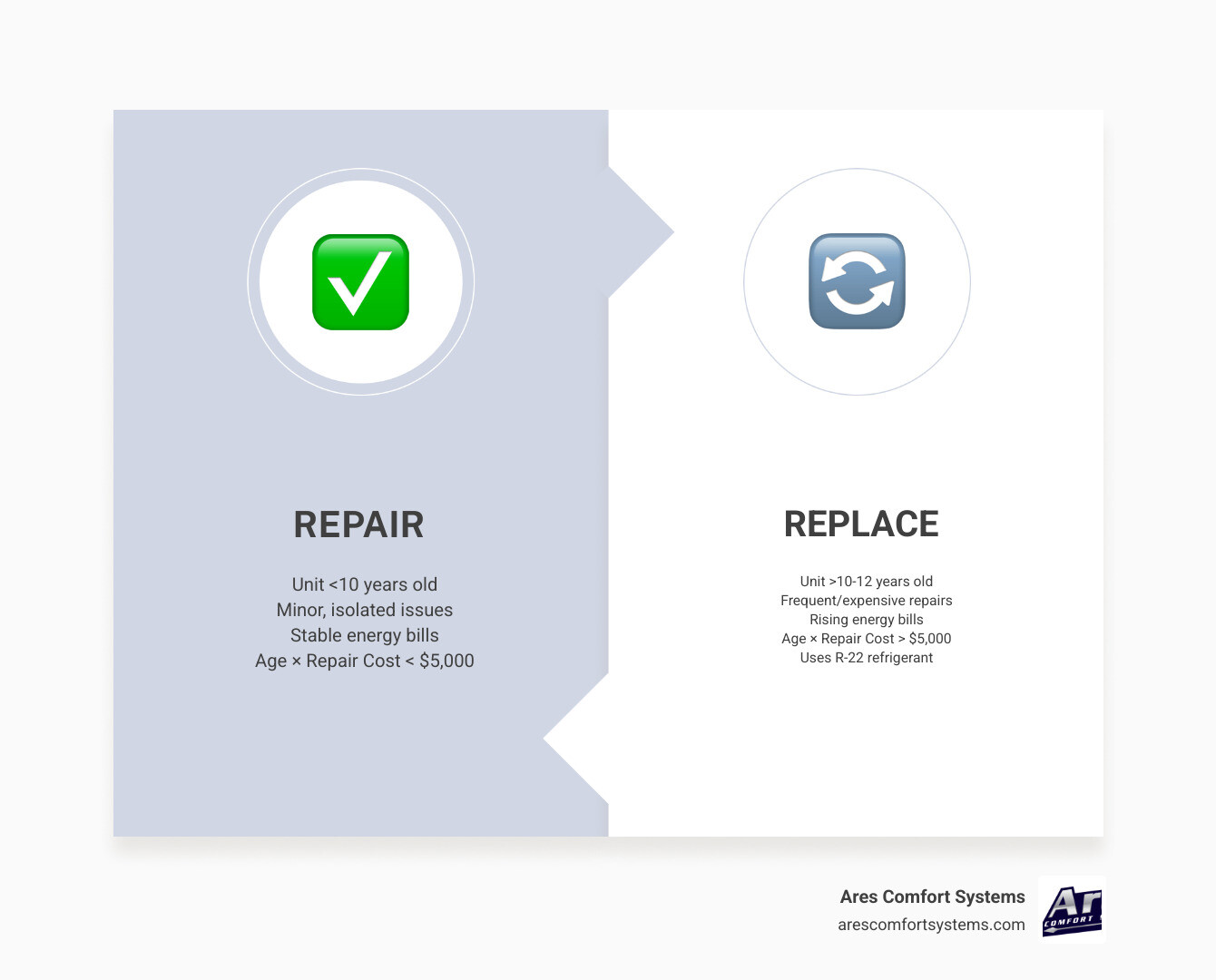
- Repair if your system is under 10 years old, the issue is minor and isolated, your energy bills are stable, and the repair cost multiplied by the unit’s age stays under $5,000.
- Replace if your system is over 10-12 years old, repairs are frequent or expensive, your energy bills keep climbing, or the unit uses phased-out R-22 refrigerant.
The $5,000 Rule is the fastest way to check: multiply your AC’s age (in years) by the estimated repair cost. If that number exceeds $5,000, replacement is almost always the smarter financial move.
For homeowners in King, Pierce, Thurston, and Kitsap Counties, Washington, this decision carries real weight. Western Washington summers are getting hotter, and a failing AC isn’t just uncomfortable — it’s a strain on your energy bill and your peace of mind.
The good news? Once you know what to look for, the choice becomes much clearer.
Using the $5,000 Rule to Decide Between AC Repair and Replacement

When we visit homes in Lakewood or Puyallup, the most common question we hear is: “Is it worth fixing this?” To answer that objectively, we often use the $5,000 Rule. This is a simple mathematical formula used throughout the HVAC industry to help homeowners avoid the “sunk cost fallacy”—the mistake of pouring money into a machine that is destined to fail again shortly.
To use the rule, multiply the age of your unit by the repair estimate. For example, if your 10-year-old AC needs a $600 repair, the total is $6,000. Since this exceeds the $5,000 threshold, the math suggests that your money is better spent toward a new, efficient installation.
Other helpful benchmarks include:
- The 50% Rule: If a single repair costs more than 50% of the price of a brand-new system, replacement is the logical path.
- The 75% Lifespan Threshold: If your unit has reached 75% of its expected life (usually around 11 or 12 years in the Pacific Northwest) and the repair costs more than a third of a new system, it’s time to call it quits.
| Criteria | Lean Toward Repair | Lean Toward Replacement |
|---|---|---|
| System Age | Under 10 years | Over 12 years |
| Repair Cost | Less than 30% of new unit | More than 50% of new unit |
| Frequency | First major issue | 2+ repairs in 12 months |
| Efficiency | Monthly bills are stable | Bills rising despite service |
| Refrigerant | Modern R-410A or R-454B | Obsolete R-22 (Freon) |
How to decide between ac repair and replacement based on system age
Age is perhaps the most significant factor in this equation. According to ENERGY STAR guidelines, central air conditioning units older than 10 years should be evaluated for replacement. While an AC unit might “run” for 15 to 20 years in some parts of the country, the reality in Washington is that parts become harder to find and efficiency drops significantly after the decade mark.
If your system is in its “late-life stage,” major components like the compressor or the evaporator coil are at a much higher risk of terminal failure. For a deeper look at what to expect during this transition, check out our complete guide to staying cool with AC replacement in Puyallup WA.
When Professional Repair is the Best Path Forward
Replacement isn’t always the answer. In many cases, a well-timed professional repair can keep your home comfortable for several more years. We generally recommend AC repairs when the system is relatively young (under 8 years) and the problem is isolated to a single, replaceable part.
If your energy bills have remained stable and the unit has been meticulously maintained through a Comfort Service Agreement, a repair is often a fantastic investment. You can learn more about identifying these situations in our article on the top signs your air conditioner needs repair.
Identifying repairable symptoms in your cooling system
Not every scary sound means your AC is dying. Many common issues are actually quick fixes for a trained technician. For instance, if you hear strange noises from your AC unit, it could simply be a loose fan blade or a failing capacitor—repairs that are significantly more affordable than a full system swap.
Common repairable symptoms include:
- Clogged condensate drains: Often caused by algae or debris, these can be cleared quickly.
- Capacitor or Contactor failure: These electrical components take the brunt of the wear and tear but are easily replaced.
- Thermostat malfunctions: Sometimes the “broken AC” is just a faulty wall unit or a dead battery.
- Minor airflow issues: Usually resolved with a professional cleaning or a filter change.
If you are experiencing these specific glitches, our team at Ares Comfort Systems specializes in HVAC repairs that restore your comfort without the need for a total overhaul.
Using repair as a bridge strategy
There are times when repairing an older unit is a strategic “bridge” rather than a long-term solution. If you are planning to move within the next year, or if your current budget is tight, a minor repair can act as a stop-gap measure to get you through the summer. However, we always provide a transparent assessment of how much life is realistically left in the system so you aren’t caught off guard by a second failure. Our AC services are designed to give you the facts you need to make the best choice for your specific timeline.
Critical Red Flags That Make Replacement Mandatory
Sometimes, the “repair” is just a bandage on a wound that won’t heal. There are certain critical red flags where we will almost always recommend a full AC installation over a repair.
The biggest red flag is the use of R-22 refrigerant (often called Freon). The EPA phased out the production and import of R-22 in 2020. Because it is no longer manufactured, the cost of sourcing this refrigerant for a leak repair has become astronomically high. If your system was built before 2010, it likely uses R-22, and any major leak essentially makes the unit economically unviable to fix.
Another terminal issue is a “blown” compressor. The compressor is the heart of your system. If it fails on a unit that is out of warranty, the cost of the part and the labor to install it often approaches the cost of a new outdoor unit. If you’re wondering if your system is at this point, read our guide on whether your AC compressor is giving up the ghost.
How to decide between ac repair and replacement based on energy efficiency
Even if your old AC is still “working,” it might be costing you a fortune in hidden expenses. Modern systems must adhere to SEER2 ratings, which measure seasonal energy efficiency. A 15-year-old unit might have a SEER rating of 10 or 12, whereas modern high-efficiency systems can reach SEER2 ratings of 18 to 25.
Upgrading to a new system can reduce your monthly cooling consumption by 30% to 50%. Furthermore, current federal incentives, such as those found in the Inflation Reduction Act, offer significant tax credits and rebates for homeowners who switch to high-efficiency cooling and heat pump systems. In places like Puyallup, central AC replacement has become a primary way homeowners improve their property value while slashing utility costs.
Long-term benefits of a new high-efficiency system
Beyond the energy savings, a new system brings a level of comfort that older units simply can’t match.
- Variable-Speed Technology: Unlike older units that are either “on” or “off,” modern systems can adjust their speed to maintain a perfectly consistent temperature.
- Humidity Control: Washington summers can get muggy; new systems are far superior at removing moisture from the air.
- Smart Features: Integration with smart thermostats allows you to control your home’s climate from your phone and receive alerts before a problem becomes a crisis.
- Environmental Impact: Newer refrigerants like R-454B have a much lower global warming potential than the coolants of the past.
When you work with Lakewood’s top AC installers, you aren’t just getting a new box outside; you’re getting a total home comfort upgrade.
The Western Washington Factor: Climate and System Longevity
Living in the Puget Sound region presents unique challenges for HVAC systems. While we don’t deal with the 110-degree heat of the desert, our high humidity and coastal salt air (especially in Kitsap and Pierce Counties) can accelerate corrosion on condenser coils.
Because we often have long periods of mild weather followed by sudden heat waves, systems that haven’t been exercised can fail exactly when you need them most. This is why regular AC maintenance is so critical in our region. A well-maintained system in Washington can last 15 years, but a neglected one may start showing signs of terminal failure at year 10.
How to decide between ac repair and replacement after a professional inspection
The most important step in how to decide between ac repair and replacement is getting an unbiased, professional diagnostic. A technician from Ares Comfort Systems will perform a “load calculation” to ensure your system is properly sized for your home—many older systems were actually oversized, which leads to frequent cycling and premature wear.
During an inspection, we look at the condition of your ductwork, the cleanliness of the coils, and the integrity of the electrical connections. We encourage you to ask your technician the following questions:
- What was the root cause of this failure?
- If I fix this, what is the likelihood of another major component failing in the next two years?
- How much could I save on my monthly bills with a higher SEER2 unit?
- Is my current ductwork sufficient for a modern high-efficiency system?
Frequently Asked Questions about AC Replacement
What is the $5,000 rule for AC units? It is a decision-making tool where you multiply the age of the unit by the repair cost. If the result is over $5,000, replacement is generally the better financial choice. For example, a 12-year-old unit needing a $500 repair (12 x 500 = 6,000) should likely be replaced.
Should I replace both the indoor and outdoor units at the same time? Yes. Modern AC systems are designed as “matched sets.” If you keep an old indoor evaporator coil and only replace the outdoor condenser, the system will operate at the efficiency of the oldest part. Furthermore, most manufacturers will not honor the full warranty unless the entire system is replaced at once.
How does the R-22 phase-out affect my decision? Since R-22 is no longer produced, even a minor refrigerant leak can result in a repair bill that is a significant fraction of a new system’s cost. If your unit uses R-22 and has a leak, we almost always recommend replacement to avoid the recurring cost of “topping off” an obsolete system.
Conclusion
At Ares Comfort Systems, we understand that choosing between a major repair and a full replacement is a big decision. Our goal is to provide you with the data and expert insight you need to make the choice that fits your budget and your long-term comfort goals.
Whether you are in King, Pierce, Thurston, or Kitsap County, our “Fixed Right Promise” and 100% satisfaction guarantee ensure that you’ll never have to worry about the quality of our work. If you’re tired of frequent breakdowns and rising bills, consider one of our Comfort Service Agreements to get your system back on track, or contact us for a free estimate on a new installation.
Ready to take the next step? Explore our full range of AC services and let us help you keep your cool all summer long.