
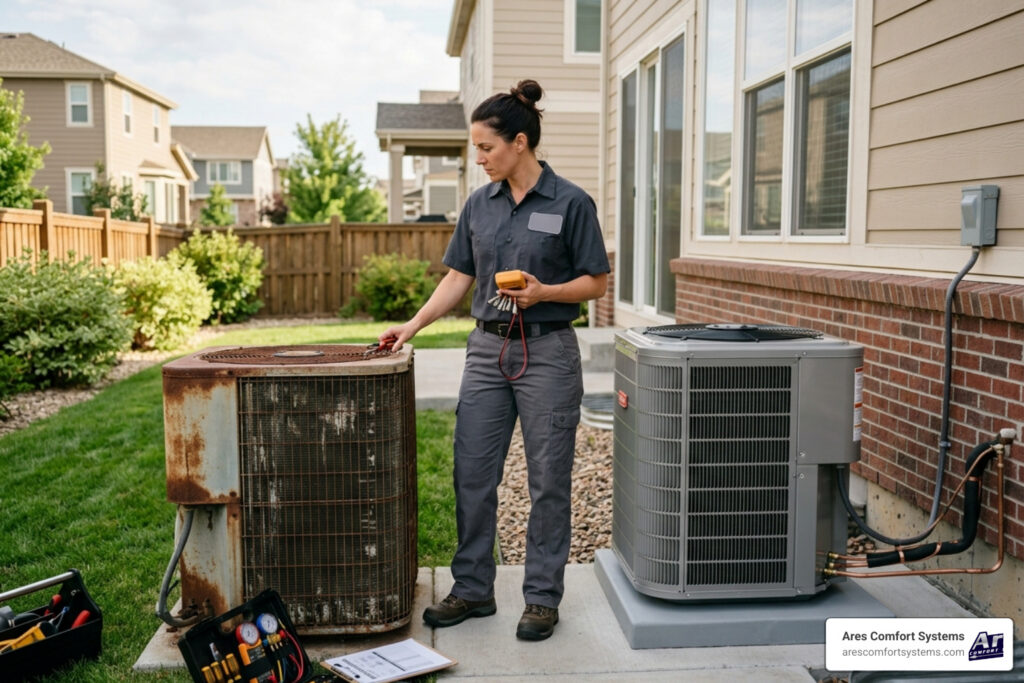
When to Repair vs Replace Your HVAC System: A Quick Answer First
Knowing when to repair vs replace your HVAC system is one of the most stressful decisions a homeowner can face — and it almost always happens at the worst possible time, like during a July heatwave or a freezing January morning.
Here is a quick decision framework before we dig deeper:
| Situation | Recommended Action |
|---|---|
| System is under 10 years old, minor issue | Repair |
| Repair cost x system age is under $5,000 | Repair |
| Repair cost is less than 30% of a new system | Repair |
| System is 12-15+ years old with major failure | Replace |
| Repair cost x system age exceeds $5,000 | Replace |
| 3 or more repairs in the last 3 years | Replace |
| System uses R-22 (Freon) refrigerant | Replace |
| Cracked heat exchanger or carbon monoxide risk | Replace immediately |
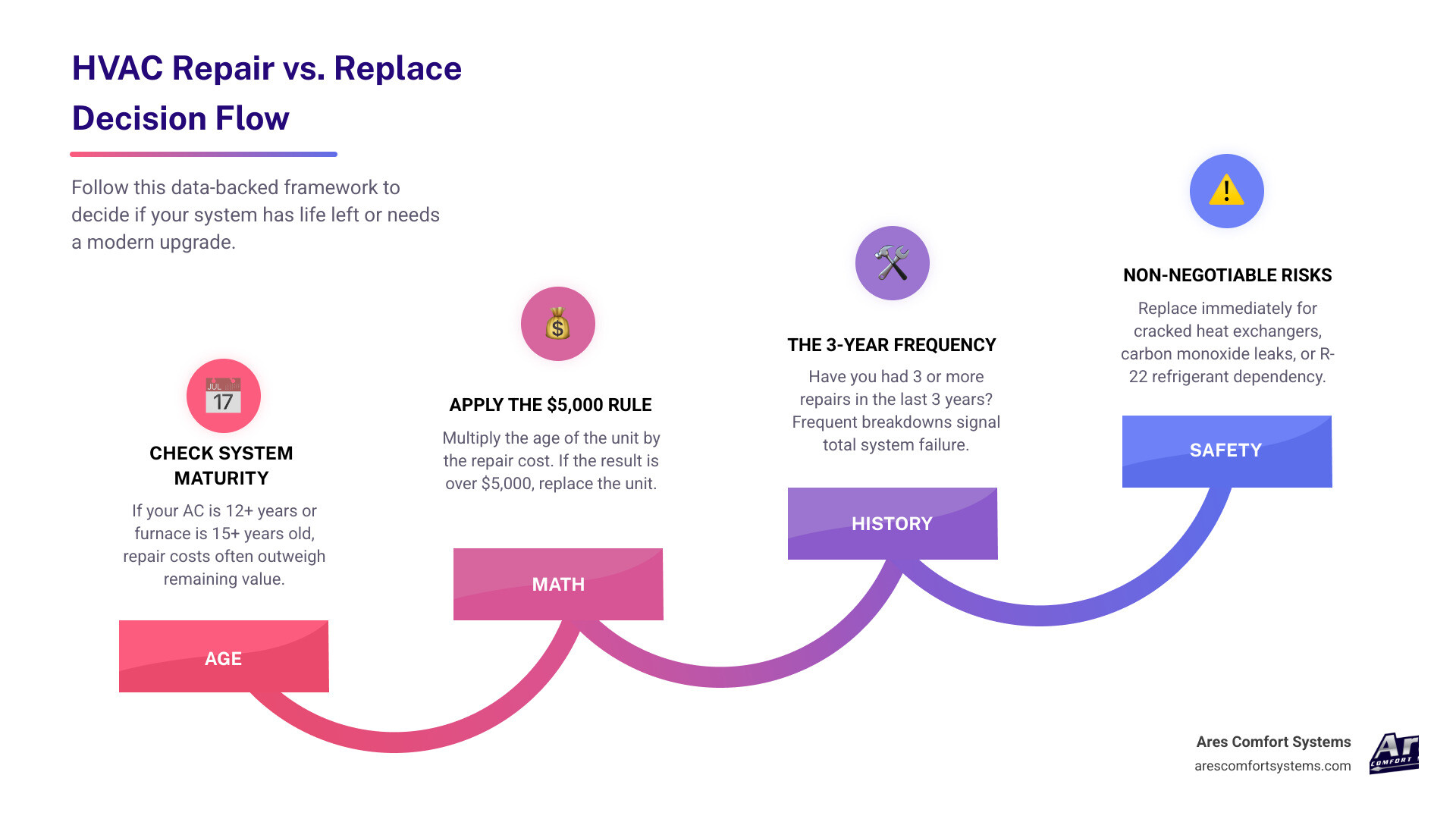
Most homeowners are caught off guard when their heating or cooling system fails. Without a clear framework, it is easy to either pour money into a dying system or replace a unit that still had good years left. The good news is that this decision does not have to be a gut feeling. There are proven, data-backed rules — like the $5,000 Rule (system age multiplied by repair cost) and the 50% Rule — that turn a stressful moment into a straightforward calculation.
In this guide, we walk you through every factor that matters: system age, repair history, energy costs, refrigerant type, safety risks, and the financial incentives available to Washington homeowners in King, Pierce, Thurston, and Kitsap Counties.
Understanding Lifespan and Age Thresholds

When we evaluate a system, age is the first metric we look at. In May 2026, many homeowners in Western Washington are finding that their units from the early 2010s are reaching a “retirement zone.” While every home is different, there are standard lifespans for HVAC equipment:
- Air Conditioners: Typically last 12-15 years.
- Furnaces: Generally have a life expectancy of 15-20 years.
- Heat Pumps: Usually last around 15 years, though their year-round use for both heating and cooling can sometimes shorten this window.
In the Puget Sound region, our specific climate plays a role. The humidity in King and Pierce Counties can lead to moisture buildup and corrosion if HVAC Maintenance is neglected. As a unit ages, its efficiency naturally declines. On average, a system’s Seasonal Energy Efficiency Ratio (SEER) rating drops by about 1 point every 4 to 5 years. If your 12-year-old AC was a SEER 13 when installed, it might effectively be a SEER 10 today, costing you significantly more to run than a modern equivalent.
When to Repair vs Replace Your HVAC System: Identifying the Red Flags
Sometimes the signs are subtle; other times, your system practically screams for help. Understanding when to repair vs replace your hvac system involves watching for these specific red flags:
Frequent Breakdowns and the “Repair Spiral”
If you find yourself on a first-name basis with your technician, it’s a sign. A common industry rule is the “Three-Year Rule”: if you have needed three or more repairs in the last three years, the system’s integrity is likely failing. You can read more about these warning signs in our guide: Don’t Sweat It: Top Signs Your Air Conditioner Needs Repair.
Rising Energy Bills
Have your utility bills steadily climbed even though your usage habits haven’t changed? Modern high-efficiency units can be up to 20-40% more efficient than models from just a decade ago. If your bills are spiking, your old system is likely working overtime to achieve the same results.
Comfort and Performance Issues
Are some rooms “iceboxes” while others feel like a sauna? Uneven temperatures, excessive dust, and “sticky” indoor air (high humidity) are indicators that your system can no longer manage your home’s load. Strange noises like banging, whistling, or grinding often signal major component failure. For example, if your compressor is failing, you may need to ask: Is Your AC Compressor Giving Up the Ghost?
Critical Safety Concerns
This is the one area where the decision is made for you. If a technician discovers a cracked heat exchanger in your furnace, it is a non-negotiable safety hazard that can leak carbon monoxide into your home. In such cases, immediate replacement is the only responsible path. Whether you need AC Repairs or Heating Repairs, safety must always come first.
The Financial Math: The $5,000 Rule and Efficiency Standards
To take the emotion out of the choice, we use mathematical formulas to help our customers in Thurston and Kitsap Counties.
| Rule Name | Calculation/Threshold | Decision |
|---|---|---|
| The $5,000 Rule | Age of Unit x Cost of Repair | If > $5,000, replace. If < $5,000, repair. |
| The 50% Rule | Repair Cost vs. New System Cost | If repair is > 50% of replacement, replace. |
| The 30% Rule | Repair Cost vs. New System Cost | If repair is < 30% of replacement, repair. |
For example, if you have a 12-year-old AC and the repair quote is $600, the math is 12 x 600 = 7,200. Since this exceeds $5,000, we would likely recommend an AC Installation instead of HVAC Repairs.
Modern standards have also shifted. As of 2026, SEER2 is the current efficiency metric. Upgrading a SEER 9 unit to a SEER 14+ unit can reduce your energy consumption by over 35%. Furthermore, the Inflation Reduction Act provides significant incentives for high-efficiency upgrades, including tax credits up to $2,000 for heat pumps and various rebates that can total thousands of dollars for eligible households.
When to repair vs replace your hvac system based on refrigerant type
The type of “juice” your system runs on is a massive factor. If your unit was installed before 2010, it likely uses R-22 (Freon). The EPA has phased out the production and import of R-22 because it depletes the ozone layer. Because the supply is now extremely limited, recharging an old system is prohibitively expensive.
If your system has a refrigerant leak and uses R-22, we almost always recommend a full replacement. Newer systems use R-410A or the even more eco-friendly R-454B. Moving to a modern system is better for the environment and your wallet. For those in Pierce County, you can find more details in our AC Replacement in Puyallup WA: A Complete Guide to Staying Cool.
When to repair vs replace your hvac system considering your time in the home
Your future plans are the final piece of the puzzle. We often suggest the “7-Year Rule”:
- Moving Soon: If you plan to sell within 1-2 years, a targeted repair might be enough to satisfy an inspection.
- Staying Put: If this is your “forever home” or you plan to stay for 7+ years, a new Heating Installation or AC unit is a strategic investment that pays for itself through energy savings and increased home value.
A new HVAC system is a major selling point. For more on how this impacts home value, see our guide on Puyallup Central AC Replacement: The Core of Home Comfort. Regardless of your choice, The Importance of Regular HVAC Maintenance cannot be overstated, as it protects your investment. We offer comprehensive AC Maintenance Services to keep your system running at peak performance.
Frequently Asked Questions about HVAC Decisions
How do I know if my HVAC system is too old to repair?
While age isn’t the only factor, systems between 12 and 15 years old are in the “high-risk” zone. If you are facing a major component failure (like a compressor or heat exchanger) and the unit is over 12 years old, the $5,000 rule usually points toward replacement.
Can a new high-efficiency unit really lower my monthly utility bills?
Yes! ENERGY STAR certified furnaces are 15% more efficient than conventional models, and high-efficiency AC units can save you up to 20% on cooling costs. Over the course of a year in Washington’s varied climate, these savings can add up to hundreds of dollars.
Is it better to replace the furnace and air conditioner at the same time?
If both units are over 12 years old, we generally recommend replacing them together. This ensures “matched performance” where the indoor and outdoor components are designed to work perfectly with one another. It also saves you money on labor costs compared to doing two separate installations years apart.
Conclusion
Deciding when to repair vs replace your hvac system doesn’t have to be a guessing game. By using the $5,000 rule, checking your system’s age, and considering the rising costs of energy and old refrigerants, you can make a choice that saves your sanity and your budget.
At Ares Comfort Systems, we’ve spent decades helping neighbors across King, Pierce, Thurston, and Kitsap Counties stay comfortable. We stand by our Fixed Right Promise and our 100% satisfaction guarantee. Whether you need a quick tune-up or a full system overhaul, we are here to provide honest, expert advice tailored to the Western Washington climate.
Ready to see which option is right for your home? Explore our full range of Services and let us help you achieve the perfect home climate.