
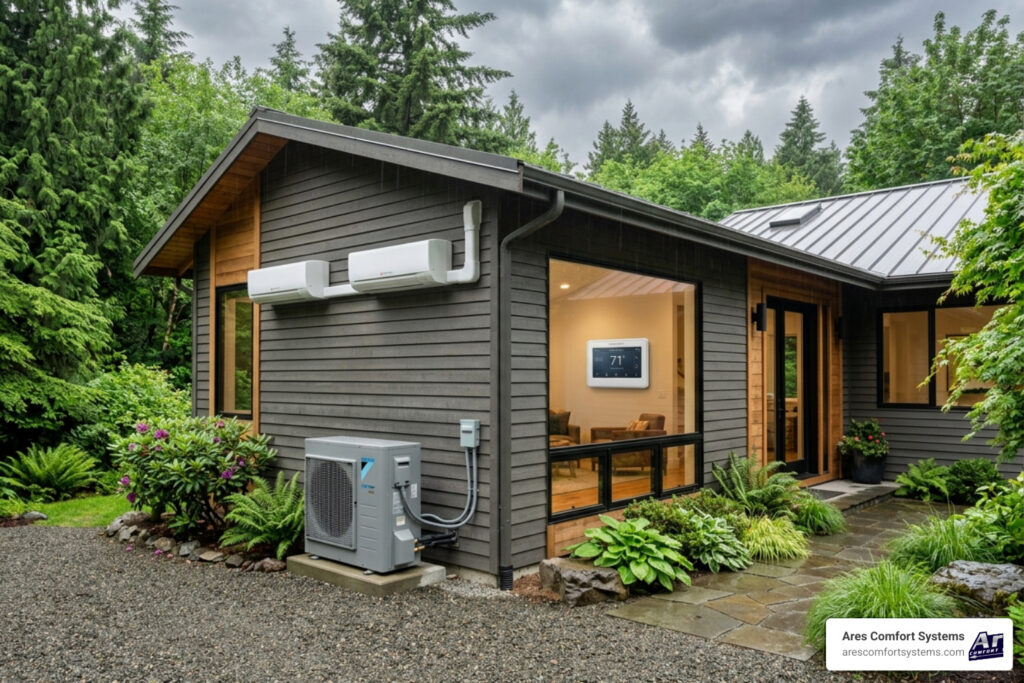
The Best HVAC Setup for Western Washington Weather: A Quick Guide
The best hvac setup for western washington weather depends on your home’s size, layout, and existing equipment — but for most homeowners in the Puget Sound region, a heat pump is the clear frontrunner. Here’s a fast breakdown before we dig into the details:
Top HVAC options for Western Washington, ranked by fit:
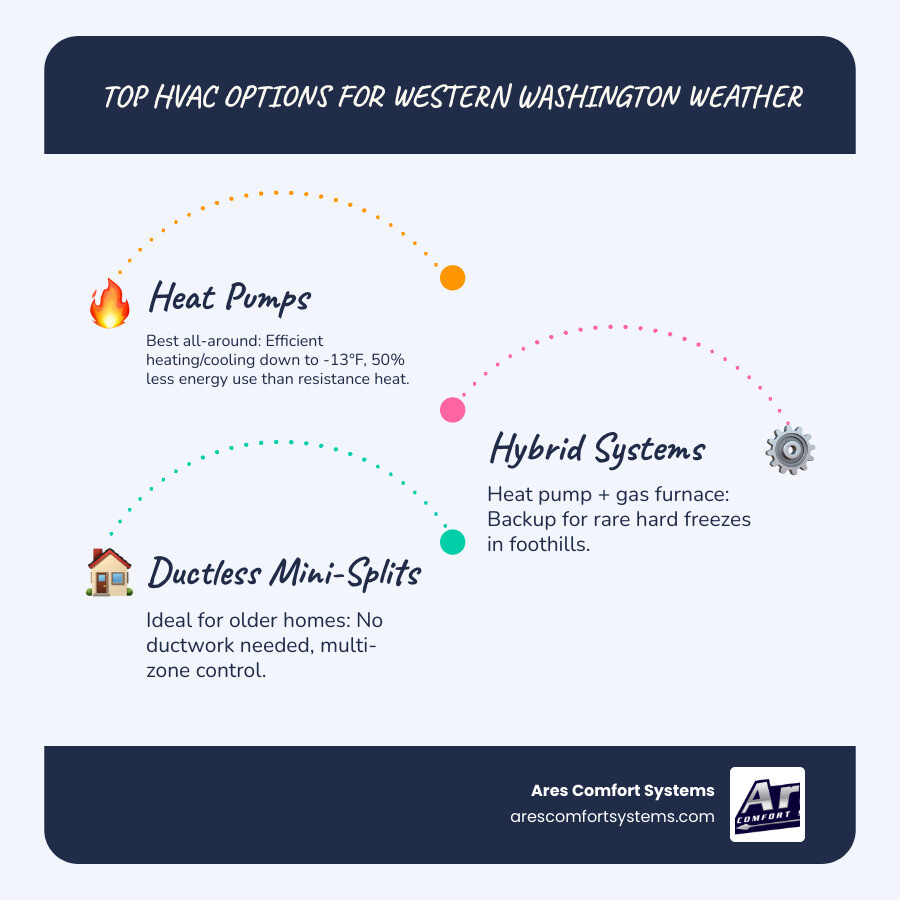
- Heat pump (ducted or ductless) — Best all-around choice. Handles mild winters and warm summers efficiently. Modern cold-climate models work down to -13°F, well below anything Seattle or Tacoma typically sees.
- Hybrid system (heat pump + gas furnace) — Best for homes in the foothills or areas that see harder freezes. The gas furnace kicks in when temps drop and the heat pump loses efficiency.
- Ductless mini-split — Best for older homes without ductwork, room additions, or upper-floor cooling problems.
- Gas furnace + central AC — Still a solid option if you already have efficient gas infrastructure and need a straightforward replacement.
Western Washington’s climate is what HVAC engineers call a marine west coast climate. Winters are long, damp, and mild — rarely dipping below the mid-20s°F in most lowland areas. Summers are short and increasingly warm, with heat events like the 2021 heat dome (which pushed Seattle to 108°F) reminding homeowners that cooling is no longer optional. On top of that, persistent humidity creates real risks: mold, musty air, and HVAC systems that cycle too fast to properly dehumidify your home.
That combination — mild but wet winters, warm summers, and year-round moisture — makes Western Washington one of the best climates in the country for heat pump technology. Heat pumps move heat rather than generate it, which makes them exceptionally efficient when outdoor temperatures stay above freezing most of the year. According to the U.S. Department of Energy, heat pumps can cut electricity use for heating by roughly 50% compared to electric resistance systems like baseboard heaters.
But “heat pump” isn’t a single answer. The right configuration — ducted, ductless, hybrid, or cold-climate — depends on your home’s specific layout and heating history. This guide walks you through every option so you can make a confident, informed decision.
I’m looking for the best HVAC setup for western Washington weather—what are my options?
When we evaluate the best hvac setup for western washington weather, we have to look closely at our unique “Marine West Coast” climate. Unlike the Midwest or Northeast, our winters are characterized by persistent dampness and temperatures that hover between 35°F and 45°F for months. Our summers are traditionally mild, but recent years have shown us that triple-digit heat waves are a real possibility.
This means your system needs to handle two distinct types of cooling: sensible heat (the actual temperature on the thermometer) and latent cooling (removing the “mugginess” or moisture from the air). In a region where the humidity often stays high, a system that cycles too quickly won’t stay on long enough to pull moisture out of your home, leaving you feeling clammy even if the air is cool.
At Ares Comfort Systems, we often recommend Heat Pumps as the primary solution for King and Pierce County homes. Because they move heat rather than creating it through combustion, they are incredibly efficient in our 40-degree winters.
| System Type | Best For | Heating Efficiency | Cooling Ability |
|---|---|---|---|
| Standard Heat Pump | Most PNW homes with ducts | High (HSPF2 8.5+) | Excellent |
| Gas Furnace + AC | Homes with existing gas | Moderate (AFUE 80-98%) | Good |
| Hybrid (Dual-Fuel) | Foothills/Colder zones | Very High (Balanced) | Excellent |
| Ductless Mini-Split | Older homes/Additions | High (Zoned) | Superior |
Why are heat pumps considered the best HVAC setup for western Washington weather?
The secret lies in the refrigerant cycle. A heat pump acts like a reversible air conditioner. In the summer, it pulls heat from inside your home and dumps it outside. In the winter, it finds heat energy in the outdoor air—yes, even when it’s 40°F—and concentrates it to bring indoors.
This process provides year-round comfort while significantly lowering your carbon footprint. When looking at systems, you’ll want to check the SEER2 (cooling efficiency) and HSPF2 (heating efficiency) ratings. Modern units often feature variable-speed compressors, which ramp up and down like a dimmer switch rather than slamming on and off. This is perfect for our “shoulder seasons” in April and October, where you might only need a tiny bit of heat to take the edge off the morning dampness. For homes without ductwork, Mini Splits offer this same high-efficiency technology on a room-by-room basis.
Is a hybrid system the best HVAC setup for western Washington weather during a freeze?
While standard heat pumps are champions in mild weather, they can lose some efficiency when temperatures drop toward the teens. This is where dual-fuel technology shines. A hybrid system pairs an electric heat pump with a high-efficiency gas furnace.
Most of the year, the heat pump handles the workload. However, during a rare Puget Sound silver thaw or a cold snap from the Fraser River Valley, the system automatically switches to the gas furnace. This “auxiliary heat” ensures your home stays toasty without the heat pump straining. If you live in higher elevations like North Bend or the foothills of Pierce County, this might be your best hvac setup for western washington weather. For those looking for cooling-only additions to an existing furnace, Ductless ACs can also provide targeted relief.
Ducted vs. Ductless: Choosing the Right Configuration for Your Layout
Your home’s physical layout dictates how air moves—or where it gets stuck. If you have a traditional home with existing floor or ceiling vents, a central ducted heat pump is often the most cost-effective path. However, Western Washington is famous for its “vintage” charm, including Craftsman bungalows and mid-century ramblers that weren’t built with AC in mind.
If you’re asking, Is a Mini Split Better Than Central Air for Your Wallet and Comfort, the answer often depends on your ductwork. Old ducts are frequently leaky or undersized for modern high-pressure heat pumps. In these cases, Ductless AC Pros and Cons for Older Homes: A Modern Solution for Vintage Spaces highlights how mini-splits bypass the “duct tax” (the 20-30% energy loss through leaky pipes in the crawlspace).
Solving Airflow Issues in Two-Story Washington Homes
We’ve all been there: the downstairs is a meat locker while the upstairs bedrooms feel like a sauna. This is a common complaint in Lakewood and Tacoma homes. Sometimes the fix is as simple as register boosters or professional duct sealing, but often the issue is deeper.
A Manual J calculation is the industry standard we use at Ares Comfort Systems to determine exactly how much heating and cooling each room needs based on window size, insulation, and orientation. If the second floor is consistently hot, a multi-zone system or an “upstairs-only” mini-split can fix the balance. For a deeper dive into how to size these systems, check out our guide on Going Ductless for the Whole House: A Sizing Guide for Homeowners.
Maximizing Efficiency and Longevity in a Damp Environment
In April 2026, as we look at rising energy costs, efficiency isn’t just about the equipment; it’s about how you use it. Puget Sound Energy (PSE) recommends setting your thermostat to 68°F when you’re home and awake. By lowering it just 7-10 degrees for eight hours a day (while you sleep or work), you can save up to 10% on your annual heating costs.
Beyond the thermostat, we recommend “weatherizing” your home to complement your HVAC. This includes:
- Weather-stripping: Sealing gaps around drafty doors.
- Attic Insulation: Ensuring you have at least R-49 to R-60 levels to keep heat from escaping through the roof.
- Solar Gain: Opening curtains on south-facing windows during our rare sunny winter days.
For more tips, see our article on Maximizing Energy Efficiency in Your Washington Home.
Essential Maintenance for Pacific Northwest Systems
Our damp, salty air in the Puget Sound region is tough on machinery. Without regular HVAC Maintenance, dust and moisture can combine to create a “sludge” on your indoor coils, leading to mold growth and restricted airflow.
We recommend changing your filters every 90 days—or more often if you have pets. Seasonal inspections are also vital. A spring tune-up ensures your condensate drain line is clear (preventing water damage) and your coils are clean for the summer heat. As we explain in The Importance of Regular HVAC Maintenance, pro-active care is the only way to hit that 15-20 year lifespan.
Protecting Your Investment from Humidity and Salt Air
If you live in Kitsap County or near the Tacoma waterfront, salt air corrosion is a real threat to outdoor units. We look for systems with specialized corrosion-resistant coatings on the fins.
Furthermore, because our air is so damp, variable-speed blowers are a must-have. These blowers run at lower speeds for longer periods, which allows the cooling coils to pull significantly more moisture out of the air than a standard “on/off” furnace. This improves indoor air quality and prevents that “musty” smell common in older PNW basements. For more localized advice, see our Tacoma Heat Pump Maintenance Because Shivering is Not a Hobby or The Lakewood Guide to Specialized Heat Pump Maintenance.
Frequently Asked Questions about PNW HVAC Systems
Do modern heat pumps require a backup heat source in Seattle?
In 2026, the short answer is: not necessarily, but it depends on the model. Modern cold-climate heat pumps use inverter-driven compressors that can maintain 100% of their heating capacity even when it’s 5°F outside. Since Seattle’s “design temperature” (the coldest it gets 99% of the time) is around 21°F, these systems are more than capable. However, many homeowners still opt for a small electric resistance backup (heat strips) or keep their gas furnace in a hybrid setup for total peace of mind during extreme weather.
How do I qualify for Washington state energy rebates in 2026?
Washington is a leader in electrification incentives. You can often qualify for federal tax credits of up to $2,000 under the Inflation Reduction Act. Locally, utilities like PSE, Tacoma Power, and Snohomish PUD offer instant rebates ranging from $800 to $1,200—especially if you are switching from inefficient electric baseboard heat to a ductless system. To qualify, your system usually needs to meet specific ENERGY STAR high-efficiency requirements. We can help you navigate the paperwork to maximize your savings.
What is the best way to handle wildfire smoke with my HVAC system?
Wildfire season has unfortunately become a regular part of Washington summers. Your HVAC system is your first line of defense. We recommend upgrading to a MERV 13 filter, which is dense enough to trap smoke particles without overworking your blower motor. If your home is particularly “leaky,” you might consider an air purifier or a whole-home HEPA filtration system. During smoke events, always set your system to “recirculate” mode to keep outdoor pollutants from being pulled inside. Learn more about why Why Your Lakewood Heat Pump is Begging for Maintenance after a smoky summer.
Conclusion
Finding the best hvac setup for western washington weather doesn’t have to be a guessing game. Whether you’re in a historic home in Tacoma, a modern condo in Seattle, or a farmhouse in Thurston County, the goal remains the same: staying warm through the damp winters and cool through the brightening summers without breaking the bank.
At Ares Comfort Systems, we’ve spent decades serving King, Pierce, Thurston, and Kitsap Counties. We understand the specific challenges of the Puget Sound—from salt air corrosion to 100-degree heat domes. Our team is committed to the Fixed Right Promise and our 100% Satisfaction Guarantee. We don’t just install boxes; we design comfort systems tailored to your home’s unique “Manual J” needs.
Ready to upgrade your home’s comfort and efficiency? Schedule your expert HVAC consultation today and let us help you find the perfect system for your Washington lifestyle.