
Why Commercial HVAC Basics for Business Owners Matter More Than You Think
Commercial HVAC basics for business owners come down to one core truth: your heating, ventilation, and air conditioning system is one of the most expensive and most critical assets in your building. When it runs well, nobody notices. When it fails, everyone does — and so does your bottom line.
Here is a quick overview of what every business owner should know:
- What it is: A commercial HVAC system controls temperature, humidity, ventilation, and air quality across large or multi-zone commercial spaces
- Why it matters: HVAC accounts for roughly 39% of a commercial facility’s total energy use — making it your single largest facility expense
- How long it lasts: Average lifespan is 12-15 years, but with proper maintenance, systems can run reliably for 20 years or more
- What it costs you if neglected: Poor upkeep can shorten system life by 8-15 years and increase energy waste by up to 40%
- How often it needs service: At minimum, twice a year for seasonal tune-ups; monthly filter inspections by facility staff
- Who handles what: Licensed technicians handle refrigerant work, electrical diagnostics, and deep servicing; your team handles daily visual checks and filter swaps
Whether you manage a small retail shop or a multi-story office building in King County, Pierce County, Thurston County, or Kitsap County, Washington, understanding how your commercial HVAC system works puts you in control of your comfort, your energy bills, and your compliance obligations.
Commercial buildings in the U.S. consume about 40% of the country’s total energy, and a significant chunk of that runs through the HVAC system. Small improvements in how you manage, maintain, and upgrade your system can translate directly into thousands of dollars saved each year — and a healthier, more productive workspace for everyone inside.
This guide walks you through everything you need to know, from system types and key components to maintenance schedules, energy-saving strategies, and when to call in a professional.
Understanding Commercial HVAC Basics for Business Owners

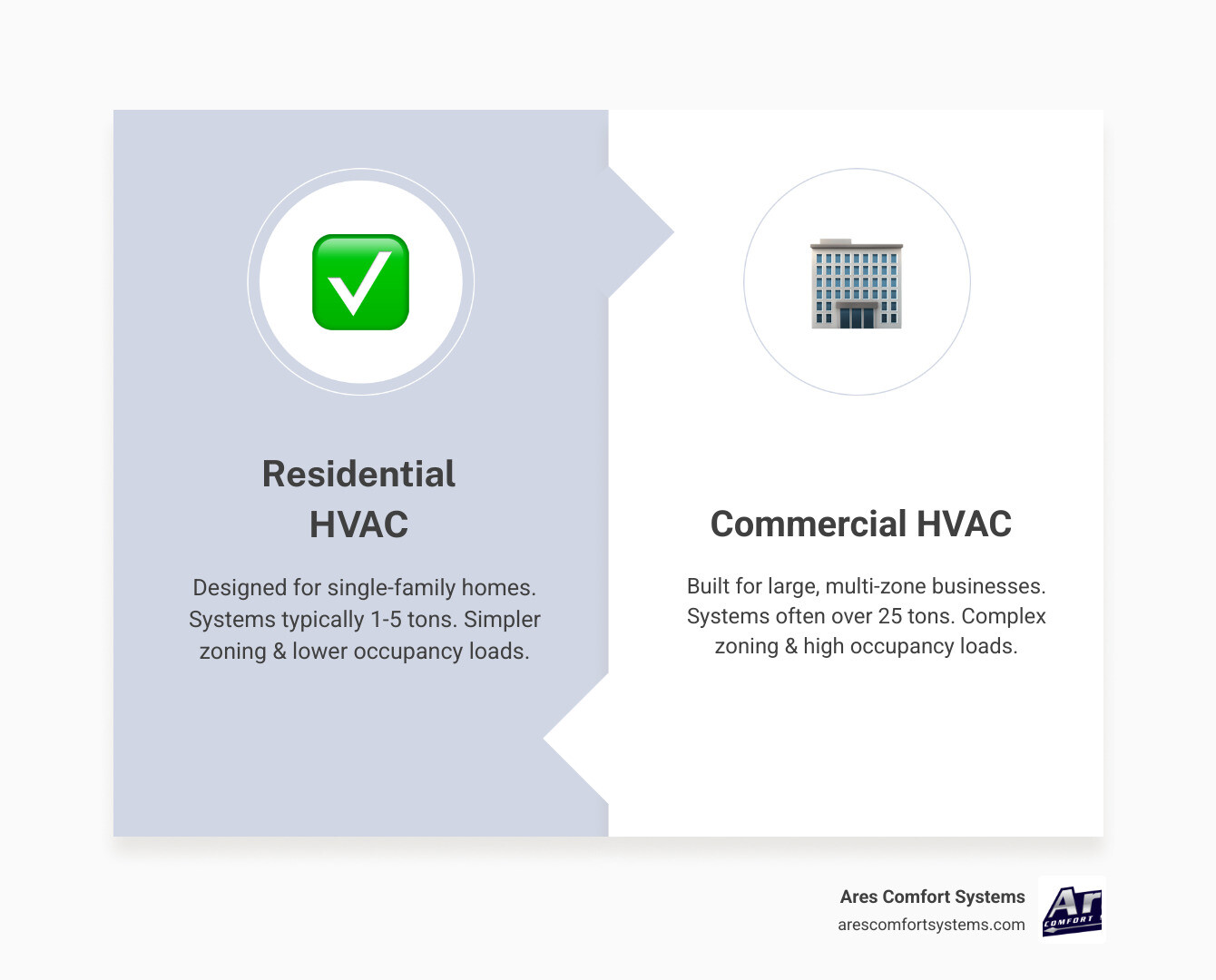
When we talk about commercial hvac basics for business owners, the first thing to grasp is the sheer scale of these systems. Unlike a residential unit that might cool a single-family home, commercial systems are built for massive occupancy loads and complex layouts. While a home AC unit is typically 1 to 5 tons, commercial systems often exceed 25 tons.
The design is fundamentally modular. This means that if one part of the system fails, it doesn’t necessarily mean the whole building loses climate control. This modularity allows for sophisticated zoning—ensuring a server room stays at a crisp 68 degrees while the retail floor remains comfortable for customers. At Ares Comfort Systems, we specialize in Commercial HVAC services that address these high-demand environments.
Residential vs. Commercial HVAC Systems: A Quick Comparison
| Feature | Residential HVAC | Commercial HVAC |
|---|---|---|
| Size/Capacity | 1–5 Tons | 25+ Tons (Often Modular) |
| Location | Ground level or backyard | Rooftop or dedicated mechanical rooms |
| Zoning | Simple (1–2 zones) | Complex (Multi-zone/Occupancy based) |
| Maintenance | Twice a year | Monthly to Quarterly |
| Complexity | Standalone units | Integrated with Building Automation (BAS) |
Key Components of a Commercial HVAC System
To manage your facility effectively, you should be familiar with the “big players” inside your mechanical room or on your roof:
- Compressors and Condensers: These are the heart of the cooling cycle, moving refrigerant to absorb and release heat.
- Air Handlers: These units circulate and regulate the air as part of the system.
- Chillers: Common in very large buildings, these use water to move heat out of the facility.
- Economizers: Often called the “best-kept secret” of HVAC, these pull in cool outdoor air for “free cooling” when the weather permits.
- Thermal Expansion Valves (TXV): These regulate the amount of refrigerant flowing into the evaporator.
Understanding these parts helps you spot trouble early. If you notice unusual vibrations or grinding noises from these components, it’s time to look into HVAC repairs before a small fix becomes a total system replacement.
Common Types of Commercial HVAC Systems
Choosing the right architecture depends on your specific business needs. Here are the most common HVAC services and systems we see in the Puget Sound area:
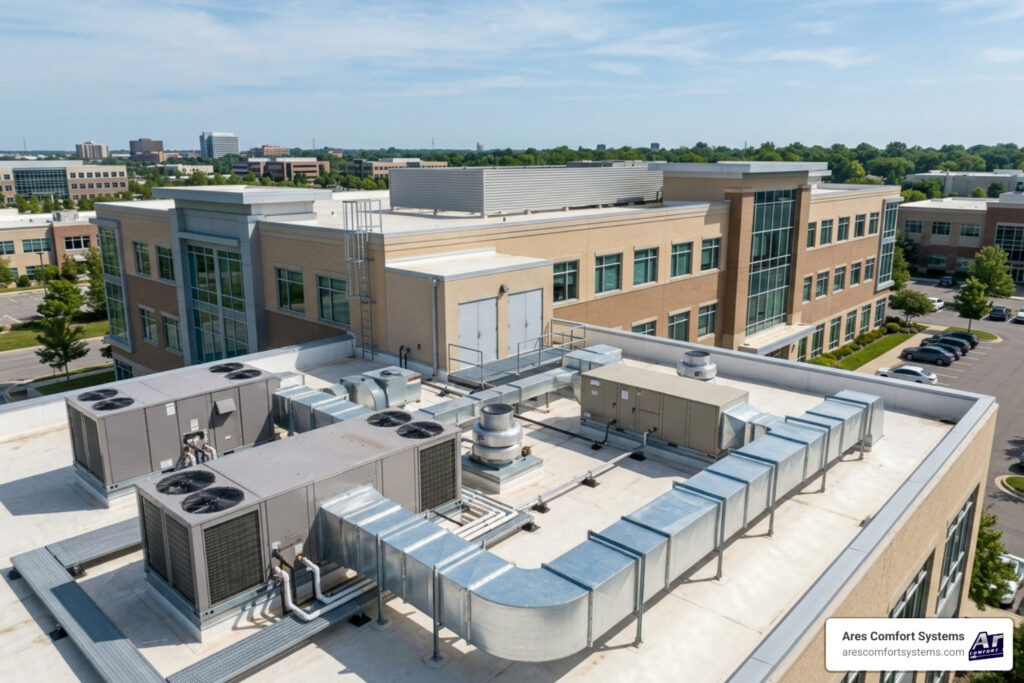
- Packaged Rooftop Units (RTUs): These are self-contained systems that house all components in one box on the roof. They are the gold standard for retail and mid-sized office buildings because they save indoor space.
- Split Systems: Similar to residential setups but larger, these have an indoor unit and an outdoor unit. They are great for smaller commercial spaces like cafes or clinics.
- VRF (Variable Refrigerant Flow): These are the “Teslas” of the HVAC world. They can heat one room while cooling another simultaneously by transferring heat between zones—offering up to 30% more efficiency than traditional systems.
- Heat Pumps: These move heat rather than generating it, making them incredibly efficient for our Washington climate.
Choosing the Right Commercial HVAC System for Your Business
Selecting a system isn’t just about picking the biggest unit. Proper sizing is critical. An undersized unit will work itself to death, while an oversized unit will “short cycle,” turning on and off rapidly, which destroys efficiency and equipment life.
We use professional load calculations (like Manual N for commercial spaces) to determine the exact cooling and heating needs of your building based on square footage, window placement, insulation, and occupancy. If you are looking to install or upgrade, our team can guide you through the hvac/ selection process to ensure your investment is protected.
Maximizing Efficiency and Reducing Operational Expenses
In 2026, energy efficiency isn’t just a buzzword—it’s a survival strategy for business owners. With HVAC accounting for nearly 40% of your energy use, even a 10% gain in efficiency can significantly impact your annual overhead.
Modern standards, such as SEER2 (Seasonal Energy Efficiency Ratio 2), have raised the bar for equipment. As of recent regulations, Energy Star certified commercial systems must have a SEER rating of at least 14.5. Moving from an older 14 SEER unit to a 16 SEER2 unit can cut cooling electricity costs by 12–15%. To keep these high-efficiency systems running at their peak, regular Hvac Maintenance/ is non-negotiable.
Energy-Saving Commercial HVAC Basics for Business Owners
How can you trim the fat from your energy bill? Start with these proven strategies:
- Smart Controls and BAS: Building Automation Systems eliminate human error. They automatically enter “eco-mode” after business hours, preventing you from cooling an empty warehouse or office.
- Variable Frequency Drives (VFDs): These allow motors and fans to run at speeds lower than 100%, matching the actual demand of the building. This can result in 15–25% energy savings.
- Demand Control Ventilation (DCV): Using CO2 sensors, the system adjusts ventilation based on how many people are actually in the room. You aren’t paying to ventilate a conference room that’s only used two hours a day.
- Economizer Optimization: Ensuring your economizers are calibrated allows for “free cooling” using our cool Washington air, reducing the load on your compressors.
Routine Hvac Inspection/ is the only way to ensure these features are actually working. An EPA study found that as little as 0.042 inches of dirt on a condensing coil can drop efficiency by a staggering 21%.
Improving Indoor Air Quality (IAQ) and Occupant Health
Indoor air quality is directly tied to your business’s success. Research from Harvard has shown that proper ventilation and humidity regulation (keeping levels between 40% and 60%) significantly improve cognitive function and decision-making for employees.
To achieve this, we recommend:
- MERV 13 Filtration: These filters trap finer particles, including many viruses and allergens, without overly restricting airflow.
- Humidity Control: Maintaining that 40-60% sweet spot prevents the growth of mold and keeps occupants comfortable.
- ASHRAE 62.1 Compliance: This standard dictates the minimum ventilation rates required to maintain acceptable air quality for human occupants.
The Critical Role of Preventative Maintenance
If there is one thing we want every business owner to know, it’s this: Preventative maintenance wins every time.
A commercial HVAC system has an average lifespan of 12 to 15 years. However, with proactive care, we regularly see these systems last 20 years or more. Conversely, reactive maintenance—only calling a technician when something breaks—is the most expensive way to run a business. Proactive care can cut energy waste by 10% to 40% and add 5 or more years of service life. Explore The Importance Of Regular Hvac Maintenance/ to see how a small investment today prevents a catastrophe tomorrow.
Maintenance Schedules and Commercial HVAC Basics for Business Owners
A “set it and forget it” mentality will cost you. We recommend a multi-tier approach to maintenance:
- Monthly: Facility staff should inspect air filters and check for visible leaks or unusual noises.
- Quarterly: For high-traffic businesses like restaurants or medical clinics, professional quarterly visits are essential to check belt tension and sensor calibration.
- Seasonally (Bi-Annually): A full professional tune-up in the spring (for cooling) and fall (for heating). This includes cleaning coils, checking refrigerant levels, and testing electrical connections.
Ongoing Hvac Maintenance/ ensures that small issues, like a loose belt or a tiny refrigerant leak, don’t snowball into a $10,000 compressor failure.
Signs Your Business Needs HVAC Repair or Replacement
How do you know when to stop repairing and start replacing? Look for these red flags:
- Short Cycling: The unit turns on and off rapidly, never completing a full cycle.
- Inconsistent Temperatures: Some rooms are sweltering while others are freezing.
- Unusual Noises: Grinding, squealing, or banging are clear signs of mechanical distress.
- Spiking Energy Bills: If your usage hasn’t changed but your bill has jumped, your system is likely losing efficiency.
- Age: If your system is over 15 years old and requiring frequent Hvac Repairs/, a high-efficiency replacement often pays for itself in energy savings within 3 to 5 years.
Compliance and Regulatory Requirements
The HVAC industry is highly regulated to protect the environment and ensure efficiency. Business owners must stay ahead of these standards:
- DOE 2023 Standards: New SEER2 and EER2 ratings are now the baseline for all new equipment.
- AIM Act and HFC Phase-down: The EPA is phasing down hydrofluorocarbons (HFCs) through 2036. This means older refrigerants will become scarcer and more expensive.
- EPA Section 608: Only certified technicians are legally allowed to handle and recover refrigerants.
Essential Maintenance Checklist for Business Owners:
- [ ] Inspect and replace filters every 1–3 months.
- [ ] Clean evaporator and condenser coils annually.
- [ ] Check and calibrate thermostats and sensors.
- [ ] Inspect belts for cracks and proper tension.
- [ ] Lubricate all moving parts (motors, bearings).
- [ ] Clear condensate drains to prevent water damage.
- [ ] Log refrigerant levels and check for leaks.
Frequently Asked Questions about Commercial HVAC
How often should commercial air filters be replaced?
Filters should be inspected monthly. In most commercial environments, they need replacement every 1 to 3 months. High-traffic businesses, or those in dusty industrial areas, may need monthly changes to maintain airflow and prevent system strain. Clogged filters are the #1 cause of avoidable HVAC breakdowns.
What is the typical lifespan of a commercial HVAC system?
The average lifespan is 12 to 15 years. However, this is largely dependent on maintenance. A neglected system might fail in 7 to 10 years, while a well-maintained system can easily reach the 20-year mark. Proactive care is the single most important factor in extending equipment life.
How do smart controls improve business efficiency?
Smart controls eliminate human error by following programmed schedules and using sensors to detect occupancy. They provide precision zoning, so you aren’t wasting money cooling an empty conference room. They also allow for remote monitoring, letting you adjust temperatures or spot alarms from your smartphone.
Conclusion
Managing a business is hard enough without worrying about your HVAC system failing on the hottest day of the year. By mastering these commercial hvac basics for business owners, you can transform your heating and cooling system from a mystery overhead cost into a strategic asset that supports your team’s productivity and your bottom line.
At Ares Comfort Systems, we are proud to serve the communities of King, Pierce, Thurston, and Kitsap Counties. We stand behind our work with a 100% satisfaction guarantee and our signature Fixed Right Promise. Whether you need a precision tune-up or a full system overhaul, our decades of experience and Comfort Service Agreements are designed to give you total peace of mind.
Ready to optimize your building’s performance? Contact us today for expert Commercial HVAC solutions and let’s keep your business running at its peak. (WA LIC # ARESCCS766CA)