


Your Best Options for Adding Cooling to a Home Without Ductwork
Adding cooling to a home without ductwork options is more straightforward than most homeowners expect. Whether you live in an older home, a historic property, or a space that was never built for central air, you have several solid paths to year-round comfort — no expensive duct installation required.
Here are the main options at a glance:
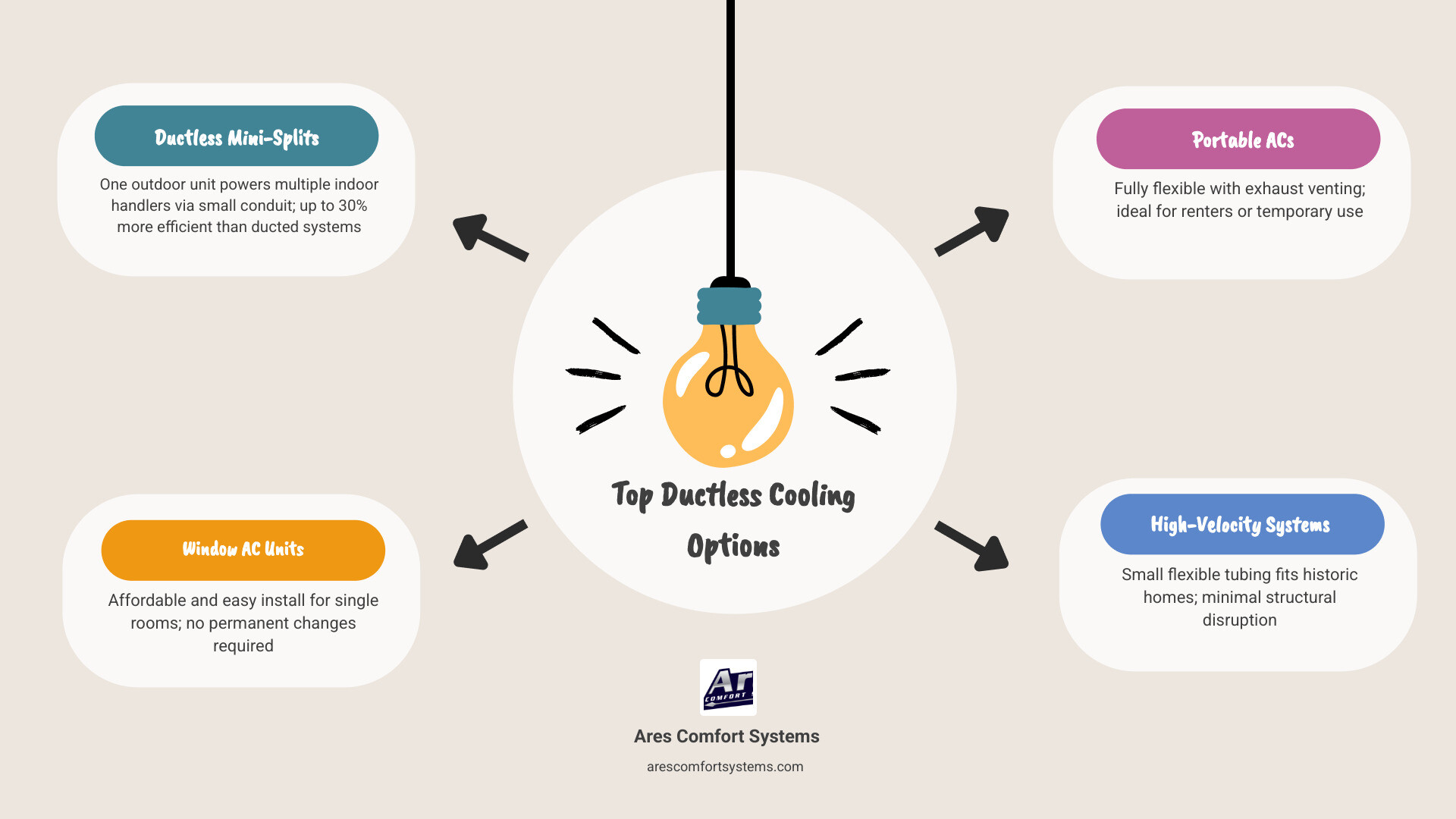
- Ductless mini-split systems – The most efficient and versatile choice; one outdoor unit connects to multiple indoor air handlers via a small conduit
- Window air conditioners – Affordable, easy to install, best for single rooms
- Through-the-wall AC units – More permanent than window units, good for dedicated rooms
- Portable air conditioners – Flexible, no permanent installation, require exhaust venting
- High-velocity HVAC systems – Use small flexible tubing instead of bulky ducts, great for older homes
- Evaporative coolers – Energy-efficient option best suited for dry climates
Most homeowners without ductwork end up choosing ductless mini-splits — and for good reason. Traditional ducted systems can lose more than 30% of their energy through leaks and gaps, especially when ducts run through unconditioned spaces like attics. A ductless system sidesteps that problem entirely, delivering cooled air directly to each room. That efficiency gap is real, and it adds up fast over a hot summer.
The good news? Installing a ductless system is far less invasive than you might think. It requires nothing more than a small 3-inch hole in the wall to run the refrigerant lines. No tearing up walls. No months-long renovation.
The Gold Standard: Ductless Mini-Split Systems
When we talk about the premier solution for modern comfort, Mini Splits are often the first recommendation we make to our neighbors in Lakewood and the surrounding King and Pierce counties. These systems are specifically designed to provide high-performance cooling without the need for a single inch of metal ductwork.
A Ductless AC setup consists of two primary parts: an outdoor condenser unit and one or more indoor air handlers. Unlike central air, which relies on a massive network of ducts to push air throughout the house, mini-splits deliver comfort directly into the living space.
One of the most impressive features of these systems is Inverter technology. Traditional air conditioners are either “on” or “off,” leading to those annoying temperature swings and high energy spikes. Inverters work more like a dimmer switch, adjusting the compressor speed in real-time to match the cooling demand. This results in incredibly high efficiency, with some units achieving SEER2 ratings as high as 35. For comparison, many standard ducted systems struggle to reach the mid-20s.
When you choose an Energy Star-certified model during your AC Installation, you aren’t just getting a cooler home; you’re investing in a system that can reduce energy consumption by up to 40% compared to conventional systems.
How Mini-Splits Work Without Ducts
The magic happens through a set of refrigerant lines housed within a small, protective conduit. This conduit connects the indoor and outdoor components through a modest 3-inch hole in the exterior wall. This means we don’t have to tear apart your drywall or sacrifice your closet space to fit bulky ducts.
Because the loud compressor is located outside, the indoor units offer whisper-quiet operation—often quieter than a library. In multi-zone setups, we can connect up to eight indoor units to a single outdoor condenser, allowing you to control the temperature in every room independently. Our Air Conditioning Services ensure that each unit is placed perfectly for maximum airflow and aesthetic appeal.
Why Adding Cooling to a Home Without Ductwork Options is Essential
In Western Washington, we see many beautiful older homes that rely on baseboard heat or radiators. For these residents, adding cooling to a home without ductwork options is essential for maintaining indoor air quality and structural integrity.
Ducts are notorious for losing 20-30% of conditioned air through tiny holes and leaks. By eliminating the middleman (the ducts), you eliminate that waste. Furthermore, zoned comfort allows you to stop cooling rooms you aren’t using. If you spend your afternoon in the home office and your evening in the living room, why pay to cool the guest bedroom? This targeted approach is a cornerstone of modern HVAC efficiency.
Alternative Adding Cooling to a Home Without Ductwork Options
While mini-splits are the heavy hitters, they aren’t the only way to beat the heat. Depending on your home’s layout and your specific needs, there are several other adding cooling to a home without ductwork options worth considering.
Best Adding Cooling to a Home Without Ductwork Options for Older Homes
For those living in historic Craftsman or Victorian homes in Tacoma or Olympia, preserving architectural charm is a top priority. In these cases, a High-velocity HVAC system can be an excellent alternative. Instead of standard 6-inch ducts, these systems use small, flexible tubing (about 2 inches in diameter) that can be snaked through walls and between floor joists with minimal disruption.
These systems use high-pressure air to cool rooms faster than traditional units, and the vents are so small they can be painted or stained to match your decor. If you are worried about the “look” of a wall-mounted mini-split, high-velocity systems offer a nearly invisible footprint. Additionally, if you find your existing ducts are beyond repair, our team can discuss Air Duct Installation or these low-impact alternatives during our AC Services.
Portable and Window Unit Considerations
If you are looking for a more temporary or budget-friendly fix, window and portable units are the classic go-to.
- Window Units: These are generally more efficient than portables and don’t take up floor space. However, they can be noisy, block your view, and pose a security risk if not properly braced.
- Portable ACs: These are great for renters or rooms where window configurations don’t allow for a standard unit. They do require a window or wall vent for the exhaust hose, and they tend to be less efficient because the unit itself generates heat while it works.
For either of these, they usually require more frequent AC Repairs and maintenance due to their “plug-and-play” nature and exposure to the elements.
Maximizing Efficiency and Performance
Choosing the right system is only half the battle; ensuring it performs at its peak is where the expertise comes in.
| Feature | Ductless Mini-Split | Window AC Unit | High-Velocity System |
|---|---|---|---|
| Efficiency (SEER2) | Up to 35 | 10 – 12 | 15 – 20 |
| Installation | Professional (1-2 days) | DIY (30 mins) | Professional (3-5 days) |
| Zoning | Excellent (Per room) | Single Room Only | Whole Home |
| Noise Level | Whisper Quiet | Moderate to Loud | Moderate (Air hiss) |
| Invasive Level | Low (3-inch hole) | None | Moderate (Small tubing) |
One of the biggest mistakes we see is improper sizing. We always perform a Manual J load calculation, which takes into account your home’s square footage, insulation levels, window orientation, and even local climate data for Washington. A unit that is too small will run constantly without cooling the room, while an oversized unit will “short cycle,” turning on and off too frequently, which kills efficiency and leaves the air feeling humid. Our AC Maintenance Services are designed to keep these precisely tuned systems running exactly as intended.
Maintenance for Longevity
To ensure your investment lasts the 15 to 20 years it’s designed for, a little TLC goes a long way.
- Filters: Most ductless units have washable filters. We recommend cleaning them every 2-4 weeks during peak summer use.
- Coils: Keep the outdoor unit clear of debris, leaves, and Puget Sound’s famous overgrown shrubs.
- Professional Inspections: At least once a year, have a technician check refrigerant levels and clear the condensate drains. This is a standard part of our comprehensive Services.
Smart Controls and Automation
Modern ductless systems are smarter than ever. Most can be integrated with your home’s Wi-Fi, allowing you to adjust the temperature from your smartphone while you’re stuck in traffic on I-5. You can set schedules, monitor your energy usage, and even receive alerts when it’s time to clean your filters. This level of control ensures you aren’t wasting money cooling an empty house while still arriving home to a perfectly chilled living room.
Frequently Asked Questions about Ductless Cooling
Can a ductless system cool an entire house?
Absolutely. While a single unit is great for a bedroom or a new addition, a multi-zone mini-split system can easily handle an entire home. By strategically placing indoor air handlers in high-traffic areas and bedrooms, you can achieve whole-home comfort. Because each unit has its own thermostat, you can keep the kitchen cool while cooking without freezing out the person reading in the den.
How does humidity affect ductless performance?
Washington isn’t the Florida Everglades, but we certainly get our fair share of humid days. Most modern ductless systems include a “Dry Mode” or dedicated dehumidification setting. This allows the system to remove moisture from the air without significantly lowering the temperature—perfect for those “sticky” spring days when it’s not quite hot enough for full AC.
Are there incentives for energy-efficient cooling?
Yes! Because ductless systems are so efficient, they often qualify for federal tax credits (up to $2,000 for certain heat pump models) and local utility rebates. Keeping an eye out for the Energy Star label is the best way to ensure you’re eligible for these savings. Over time, the lower monthly power bills often pay for the difference in upfront cost compared to less efficient options.
Conclusion
At Ares Comfort Systems, we understand that every home in the Lakewood and Kitsap County area is unique. Whether you’re trying to cool a historic bungalow or a modern loft, adding cooling to a home without ductwork options shouldn’t feel like a compromise.
We stand behind our work with a 100% satisfaction guarantee and our Fixed Right Promise. With decades of experience serving Washington homeowners, we can help you navigate the sea of options to find the perfect fit for your lifestyle and budget. Our Comfort Service Agreements even offer ongoing discounts to keep your system in top shape for years to come.
Ready to upgrade your home comfort? Explore our professional Air Conditioning solutions today!